A powerful new tool for tackling calf crypto challenges
Calf scours is arguably one of the most common diseases of newborn calves, and the consequences on animal welfare – as well as the heart break for those managing the calves – can be devastating. Words Sarah Perriam-Lampp.
The potential lifetime impact on a calf’s future productivity if it contracts Cryptosporidiosis (“crypto”) has long been one of the most frustrating challenges for calf rearers. A survey* detected 96% of New Zealand farms had calf scours causing pathogens.
For years, farmers and vets have relied on a mix of hygiene, shed management and intensive treatments to manage crypto once it appears.
MSD Animal Health is launching the world’s first vaccine, which targets this costly parasite in calves, Bovilis Cryptium, offering dairy farmers a new way to shift from firefighting outbreaks to preventing them. While existing vaccines such as Rotavec Corona have helped protect against rotavirus, coronavirus and certain strains of E. coli, there has never been a vaccine option for crypto in New Zealand – until now.
Bovilis Cryptium enables the dam’s immune system to produce antibodies against crypto. These antibodies are then transferred into her colostrum and transition milk. Correct colostrum management can ensure the calf receives these protective antibodies through passive transfer to the calf.
Andrew MacPherson, Technical Advisor – Livestock, MSD Animal Health, explains the vaccine is the outcome of more than 20 years of research and development. It has already been used in Ireland and parts of Europe since 2024 and has undergone a rigorous approval process before being cleared for use in New Zealand.
“Overseas vets who have used the vaccine are calling it a potential game changer,” says Andrew.
How does Crypto affect young calves?
Crypto is a protozoal parasite that attacks the small intestine of the calf, blunting the villi (the tiny “fingers” lining the gut) and slashing the surface area available for absorbing nutrients. The result is diarrhoea, rapid dehydration, and a big hit to early growth – with long‑term consequences for lifetime performance.
The parasite is also incredibly efficient at spreading, so vaccination is key. Infected calves can shed billions of oocysts (eggs) a day. Oocysts are highly resistant to many common disinfectants and can persist in the environment for months. It only takes a small number (17 oocysts) to infect the next calf.
Beyond the animal health and production costs, crypto is a ‘zoonosis’ which can infect people. Outbreaks around calving time can make staff sick, particularly children, the elderly and anyone with a weakened immune system.
How to use the Bovilis Cryptium vaccine?
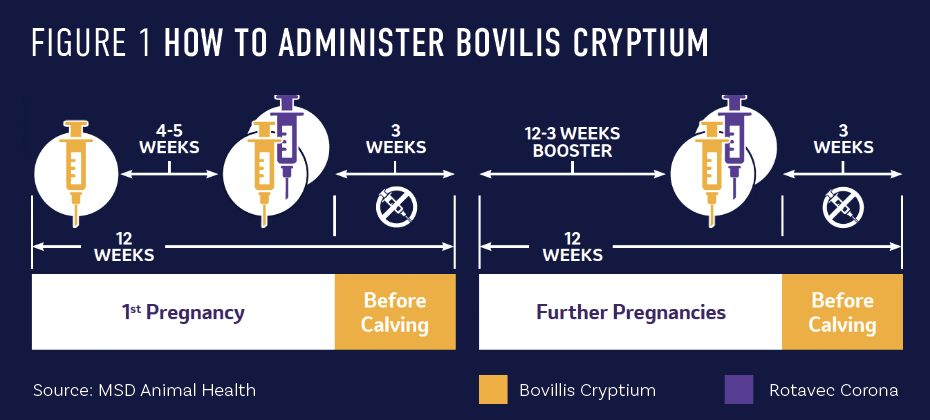
While farmers should work with their vet on a plan that fits their herd, the recommended approach is:
In the first season give 2 doses of Bovillis Cryptium, 4-5 weeks apart, in the 3rd trimester of pregnancy. To be completed at least 3 weeks before calving.
In subsequent years, an annual booster is given 12-3 weeks before calving.
In practice, Bovilis Cryptium and Rotavec Corona can be given on the same day at different vaccination sites.
How does it works?
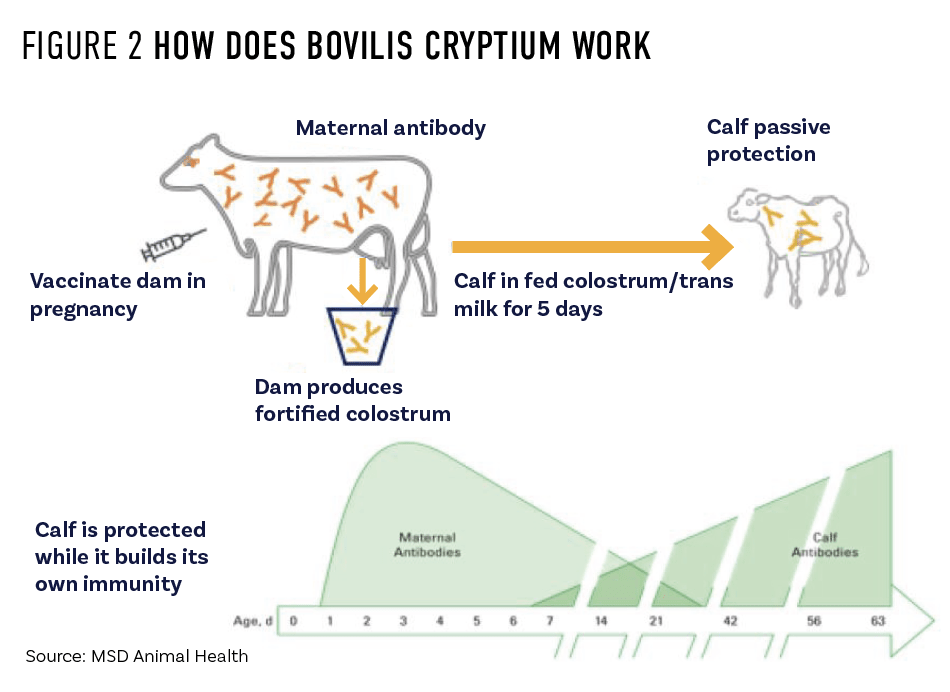 The dam’s immune system produces antibodies against crypto. Those antibodies are concentrated in the colostrum and then in transition milk. The newborn calf receives protection by drinking that milk. This approach means success relies on both an effective vaccination programme and disciplined colostrum management. The vaccine does not replace good calf rearing practices.
“Remember, the calf’s gut can only absorb antibodies from the colostrum for roughly the first 24 hours, so early feeding is critical. Aim to feed 10–15% of the calf’s bodyweight in colostrum in the first six hours of life,” says Andrew.
He adds, colostrum should continue to be fed, followed by transition milk, for at least the first five days to ensure the antibodies generated by the vaccine actually reach the calf in time to provide meaningful protection.
visit boviliscryptium.co.nz