Dairy drench resistance bell rings loud
Drench resistance has plagued sheep farmers for years. Mary Bowron from Wormwise stresses that with an estimated one in three farms facing triple drench resistance, this could mean losses of around $80,000 annually. Words Mary Bowron.
There is limited information on cattle drench resistance compared to sheep, but what is available is not reassuring.
Annual reviews of sheep faecal egg count reduction test (FECRT) results by Awanui Veterinary have provided a comprehensive picture of the deterioration of drench efficacy on New Zealand sheep farms.
A similar decline in drench efficacy is likely to be happening in New Zealand cattle worms. Former AgResearch parasitologist, Dave Leathwick, estimates that the cattle sector is only five to ten years behind the sheep sector, with respect to how extensive resistance is. With no new drench products on the horizon, this is a scary prospect.
Sick calves are being reported as current drenches are failing. This was evident in reports made by Sauermann et al (2024) and Riddle (2024), where investigation of farms with disappointing animal growth rates and poor response to drenching found resistance in Cooperia to triple combination drenches.
“The Wormwise survey found triple combination resistant Cooperia in 55% of tests and 63% of tests also showed resistance to commonly used ‘mectin/levamisole combinations.” – Mary Bowron, Wormwise
Both the Sauermann and Riddle studies involved farms that had an idea they may have drench resistance, so there was already bias towards finding a problem. But farmers shouldn’t wait until there is an obvious issue before testing to see if the drenches being used are effective. The horse has already bolted at that point.
The most recent cattle drench survey by Wormwise (Dodunski 2024) summarised FECRTs taken across New Zealand from 2021 to 2024. This emphasised the growing number of worms resistant to double and triple combinations as reported in previous studies involving a smaller number of farms.
The common intestinal worm, Cooperia, was found to be resistant to drenches in 56% of tests, and the more worrying Ostertagia was resistant in 34% of tests.
Fifty-nine different drench tests from 16 farms around NZ were collated. While it wasn’t a big number, it covered the length of the country and all of the common drench products. The majority of farms were dairy support or bull beef blocks.
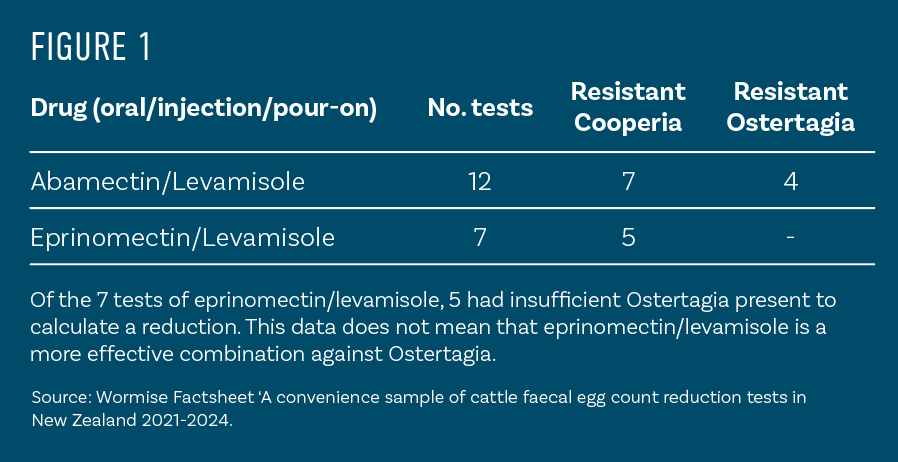
Levamisole products have been the mainstay for managing resistant Cooperia for a long time, but this now appears to be under threat – see Figure 1.
It was a similar picture for the more damaging Ostertagia. This parasite causes thickening and inflammation of the lining of the fourth stomach (abomasum) and can cause severe disease and even death in calves and older cattle.
The ‘mectin drench family has been the backstop for Ostertagia control for a long time, but the survey highlighted failure of this drug with 45% of tests showing resistance to an oral triple combination. Half of the tests showed resistance to an abamectin/levamisole injection.
The farm systems most at risk are those dominated by cattle under one year of age, and where drench has been the main means of controlling gastrointestinal nematodes.
Just as in sheep farm systems, you can’t assume anymore that using a combination drench will get rid of all the worms in your young cattle.
However, having drench resistance is not a death sentence; but significant changes in the farming system need to happen to effectively manage parasites in R1 cattle.
Whether it be a bull-beef system, dairy heifer replacements or cow-reared beef weaners, offering young animals a high-quality forage, with low parasite larval contamination, minimises the exposure of young cattle to parasites. This is a significant part in decreasing reliance on drench to treat the worms.
Ongoing monitoring of animal growth rates, faecal egg counts in cattle under 9 months of age and targeted use of drenches are key components of a successful parasite management programme.
Other tools in the Wormwise toolbox included integrated grazing with older cattle and if available using alternate species such as sheep and deer. By and large they don’t share parasite species with cattle.
Continuing to use drenches as the only parasite control method without adjusting farm practices will eventually lead to failure. Drench failure could be closer than you think. Before your next calf drench, speak to your animal health adviser about a post-drench faecal egg count.
References: Riddle G; Managing cattle triple drench failure in Northland. Proceedings of the Sheep & Beef Cattle Veterinarians and the Deer Veterinarians Branches of the NZVA, Volume 2024 Proceedings, pp 61-63. Sauermann C, Waghorn T, Miller C, Leathwick D; Simultaneous resistance to multiple anthelmintic classes in nematode parasites of cattle in New Zealand. Veterinary Parasitology 2024 Jan: 325:110079. doi: 10.1016/j.vetpar.2023.110079. Epub 2023 Nov 19.
Click her for Wormise’s paper on Managing internal parasites in calves – Beef + Lamb NZ.