Dairy farm net zero by 2032
The Net Zero Pilot Dairy Farm in Taranaki is giving farmers valuable insights into the levers they could pull to reduce greenhouse gas emissions (GHG), sharing what’s working and what tactics they should assess with caution. Words Anne Lee.
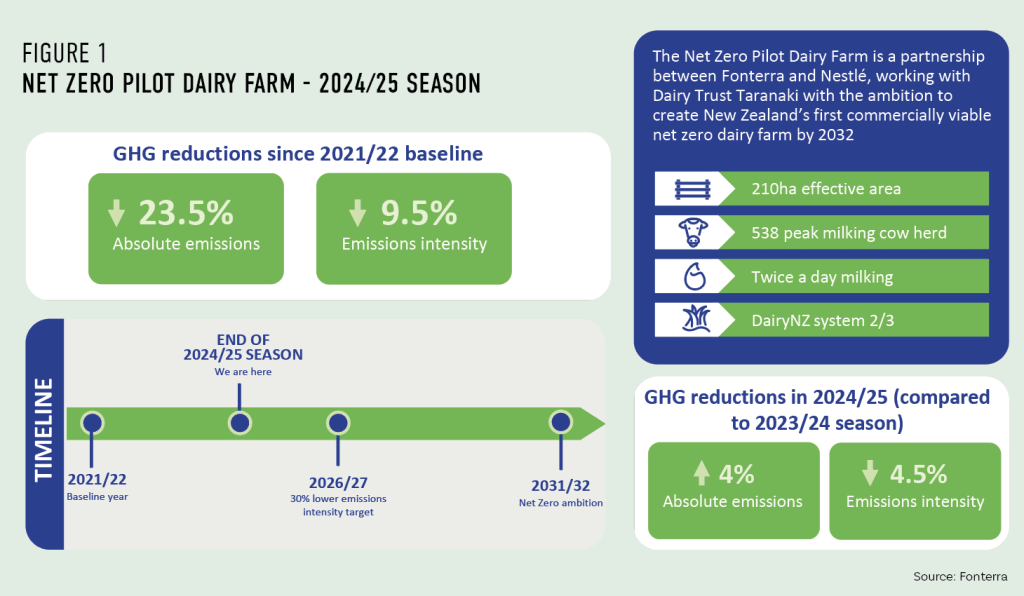
Having now completed its third season, the Net Zero Pilot Dairy Farm in Taranaki has managed to nearly double its reduction in emissions intensity compared with the 2021/22 base year, taking it from a 5.5% reduction in 2023/24 to 9.5% in 2024/25.
Fonterra Programme Manager for On Farm Excellence, Dr Talia Grala, says the aim is for the farm to be net zero by 2032 and to achieve the milestone of a 30% reduction in emissions intensity by next season.
Emissions intensity is a measure of emissions relative to milk production and is measured as kilograms of carbon dioxide equivalents per tonne of fat and protein corrected milk (kg CO2e/T FPCM). The aim is for both emissions intensity and absolute emissions to be net zero by 2032.
Last season’s big drop in emissions intensity didn’t come with a fall in absolute emissions. That number bumped back up slightly and is now at 23.5% below the baseline year, whereas in the previous season it was 27% below.
Talia explains the tactic to move to flexible milking (10 milkings in seven days) in previous seasons had meant a drop in milk production of about 12% from the baseline year and this had affected emissions intensity.
A return to twice-a-day milking last season boosted production by 9.5%, lowering emissions intensity significantly, but the corresponding increase in feed intake boosted absolute emissions by 4%.
Supplement use is lower than the baseline year with about 300kg drymatter (DM)/cow bought in last season. The type of supplement has changed too, with palm kernel use phased down in favour of a supplement mix with lower embedded emissions including sunflower pellets, dried distillers’ grain (DDG) and wheat.
Overall, the feed changes have slashed emissions from bought-in feed by 74% compared with the baseline year.
Cow variation in emissions
LIC has ranked the herd on a kilogram of milksolids (MS) per kilogram of liveweight basis revealing a significant opportunity to cut emissions. The top 25% of the herd by LIC’s rankings was found to produce about 16% less methane/kg MS than the bottom quartile.
Across New Zealand, LIC has found similar variations within herds of between 13-16%.
“That’s given us the confidence that by focusing on our breeding there are some real opportunities to be made on-farm,” she says.
The farm team has used sexed semen for the past three seasons, initially over the top 60% of the herd by breeding worth (BW) and then over the top 40%.
“When we started, we had just over 12% replacements coming from our bottom quartile animals (on BW). Last season we dropped that to 6.5% and we’ve now dropped that to 1%,” she says.
The BW of replacements has jumped from 290 to 400 as a result.
The farm’s Farm Insights report from Fonterra has consistently identified lameness as an area to work on and last season the farm team brought in lameness expert veterinarian Neil Chesterton who identified areas affecting cow flow at milking, use of the backing gate and slippery surfaces in the yard as problems.
The farm team underwent a training session with Neil, an additional sensor has been installed on the backing gate to ensure cows always have enough room, matting has been laid and new technology, Herd-i, has been installed to help identify lame cows early.
A trial last season, using EcoPond on a subsample of effluent, found a 97% reduction in methane, so the farm is moving to use the technology to treat all effluent this season. That’s likely to result in an overall methane reduction for the farm of more than 4.5%.
Silvopasture
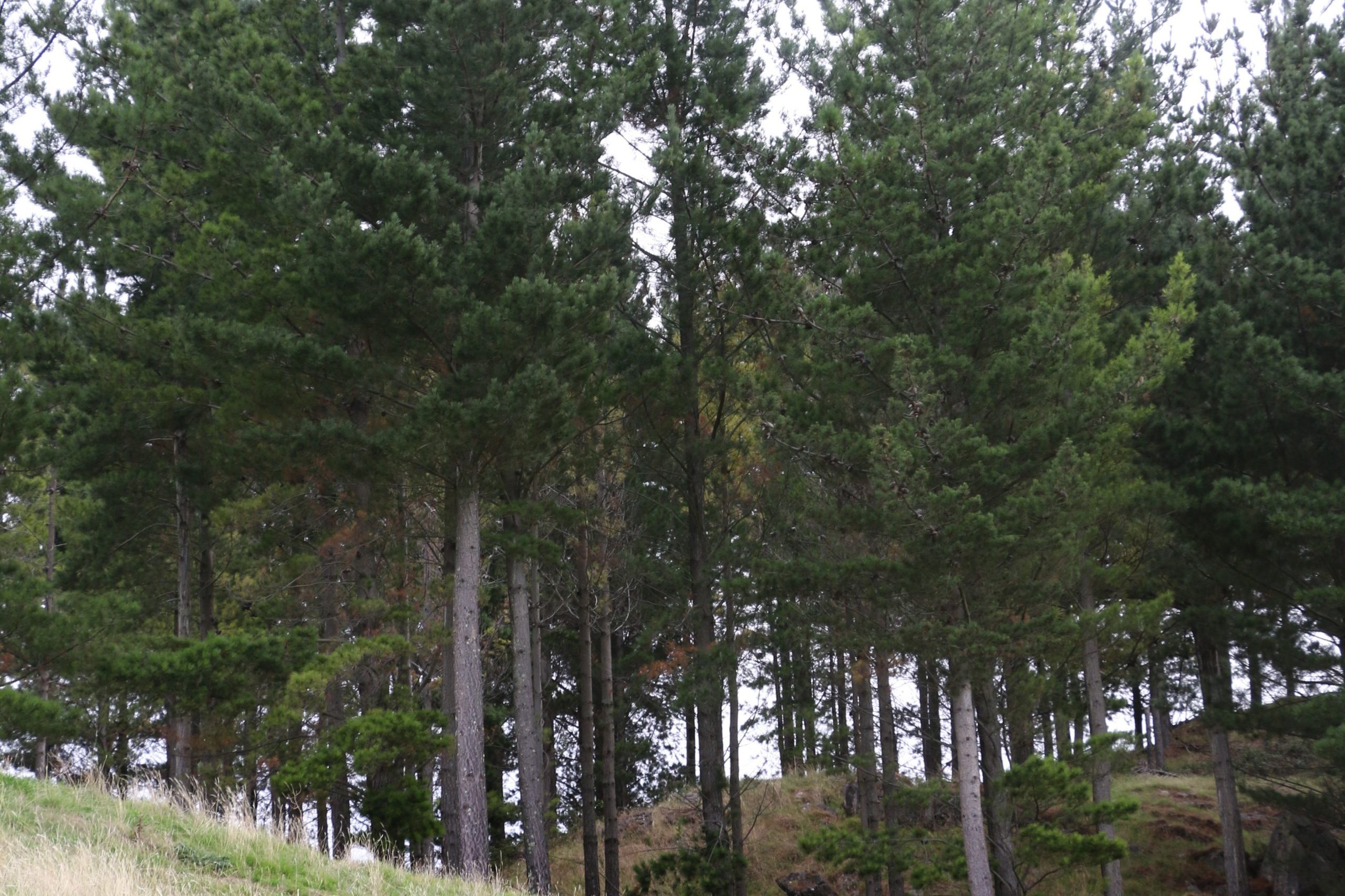
A longer term silvopasture study is looking at how trees can be integrated within paddocks to create carbon sequestration and animal welfare benefits, while not creating negative impacts for farm management and pasture growth.
In the 2024 winter, 220 Kānuka and Griselinia plants, selected for their salt tolerance and other attributes that make them suitable to the location, were planted in a grid like pattern in a 4ha paddock. Two planting densities of 40 stems/ha and 70 stems/ha were planted to get an idea of what will give the desired benefits while working practically on-farm.
Different tree guards have been trialled during the establishment phase with cows also accessing the paddock for grazing. A hardy, Ekidna tree guard, which mimics a thorny plant, has given good protection to date.
Over time the study will look at impacts of the plantings on pasture growth to see if there are any positive or negative effects from the trees at each density. Carbon storage, both in the trees and the soil, will be measured and note taken of farm management effects.
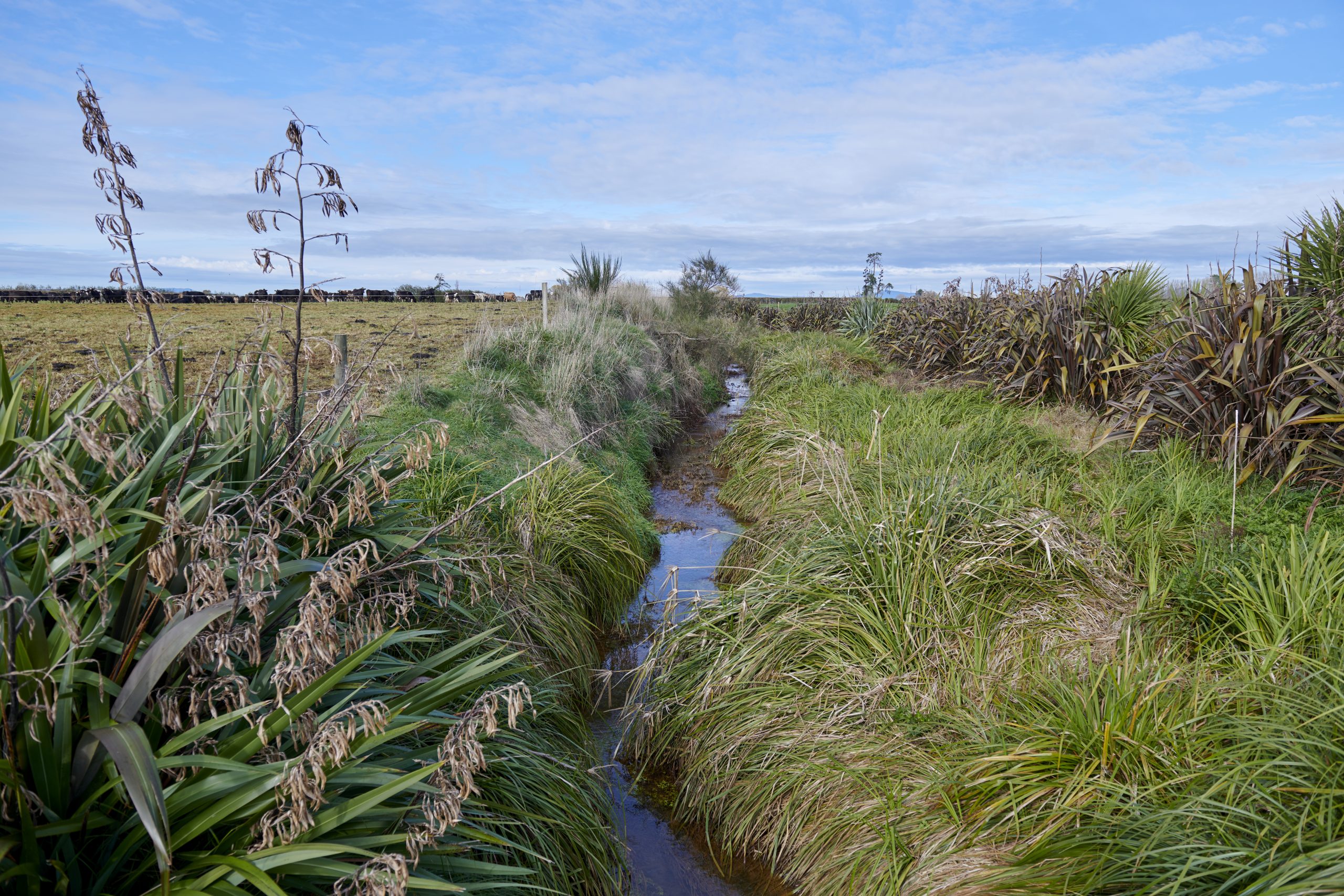
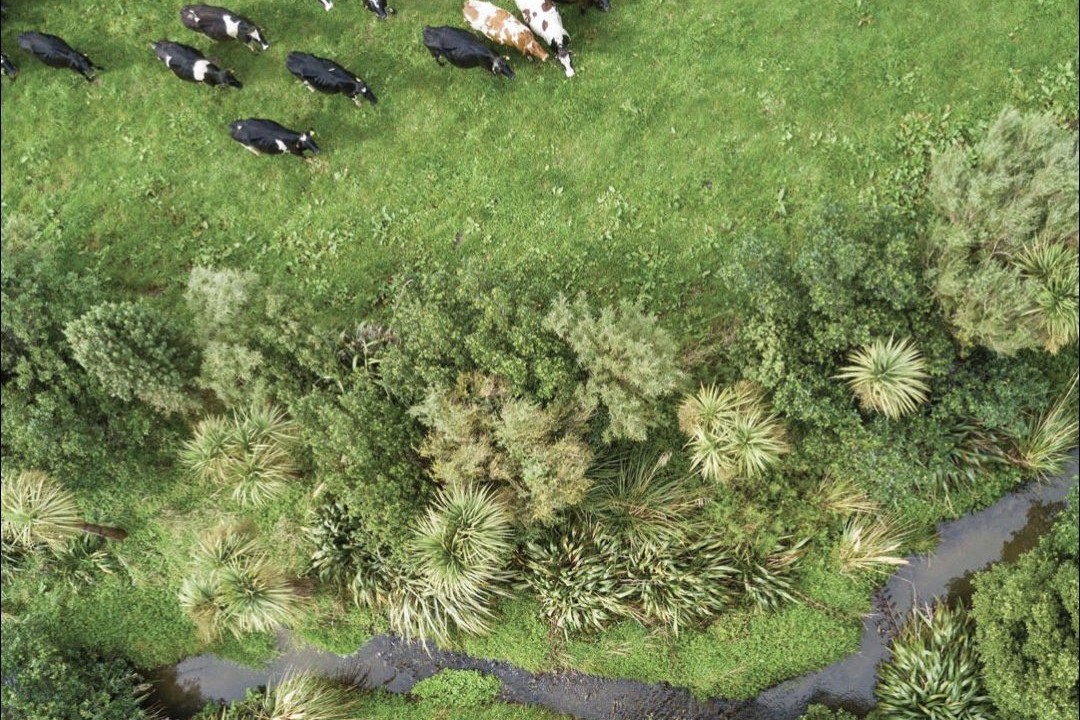
Extensive riparian planting has been carried out on the farm over the past 20 years.
“What we’re finding is that on the borders of those riparian margins, we’re able to infill with some woodier species so we can get the double whammy where we’re supporting the ecosystem that’s there, while also selecting trees that can give us more of a carbon benefit,” Talia says.
Fonterra’s new Carbon Removal Tool identifies vegetation on-farm, enabling the Co-operative and farmers to account for carbon capture and benefit from additional plantings in riparian areas.
Solar panels were installed in 2024 so they angle east to west, which slightly flattens the supply curve but ensures better supply morning and afternoon when energy draw is greatest around milking.
“We’re looking at maybe 0.5 to 1% reduction (in emissions) from the solar but I’m definitely not going to turn my nose up at that. To get to net zero, we’re going to need everything we can get.” – Talia Grala, Fonterra
Talia estimates the system will have paid for itself within 4.5 years.
“We’re getting about 50% of our electricity use met by the solar system. In terms of GHG reductions, it’s not huge because New Zealand has a lot of renewable electricity supply.
“We’re looking at maybe 0.5 to 1% reduction (in emissions) from solar but I’m definitely not going to turn my nose up at that. To get to net zero, we’re going to need everything we can get.”