Eyes wide open on Canada
Canadians find themselves caught between trade negotiations with the world’s two largest economies, the United States and China, and their diversification plans greatly concern New Zealand dairy exporters. Words Sarah Perriam-Lampp.

As Canada looks to divert its global exports of dairy protein volumes into markets other than the US, the potential for trade disruption to spread is hot in New Zealand dairy exporters’ sights as 2026 kicks off.
Canada disputes the claim that their exports will distort markets, saying the volumes involved are too small to be a concern.
However, Dairy Companies Association of New Zealand (DCANZ) executive director, Kimberly Crewther, says Canada’s policies are distorting global dairy trade.
“Even small volumes of subsidised exports have material impacts on international trade, prices and farmgate returns in New Zealand,” explains Kimberly.
She says that she is increasingly alarmed by the way Canada’s domestic dairy policy is spilling over into world markets in ways contrary to Canada’s trade commitments and obligations – and is urging a proactive defence of New Zealand’s trade interests.
“Even small volumes of subsidised exports will erode returns for New Zealand’s unsubsidised dairy producers.” – Kimberly Crewther, executive director, DCANZ
At the heart of the issue, explains Kimberly, is a simple but powerful contradiction. Canada has built a highly protected dairy system, effectively creating a fortress around its domestic market. In doing so, and attempting to match domestic milkfat supply to demand through a system of production quotas, it has engineered a surplus of dairy solids non-fat (SNF) (mainly milk protein) and then uses a complex pricing system to push it into export markets in a highly subsidised way.
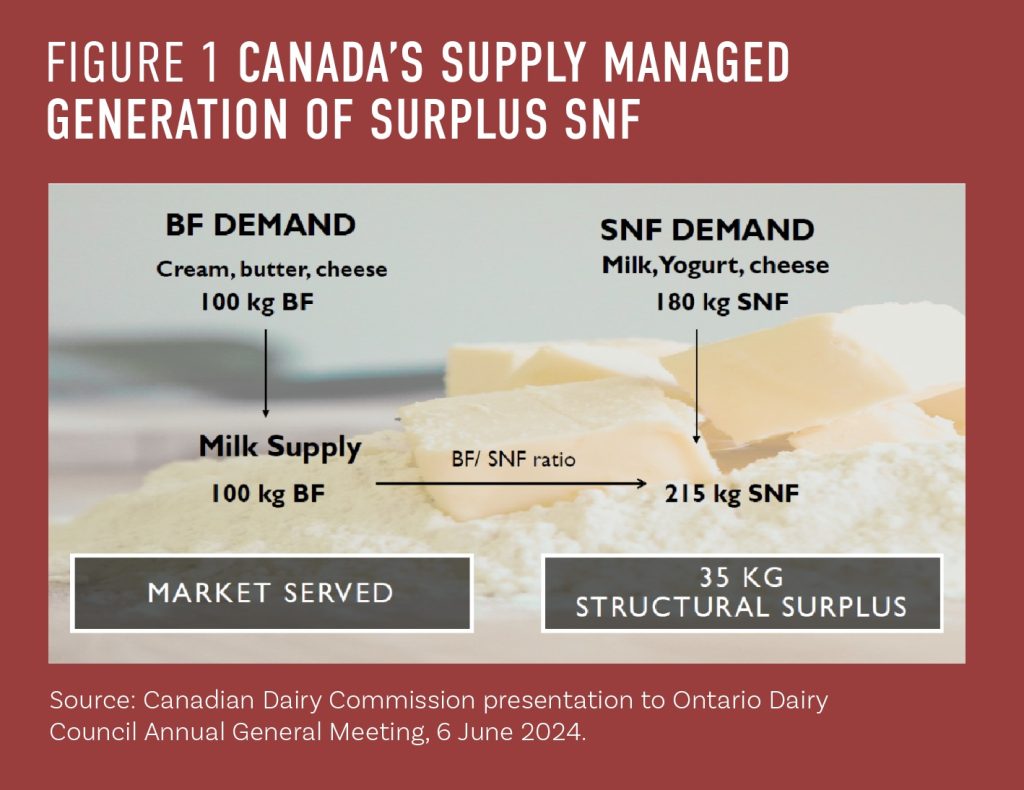
A June 2024 Canadian Dairy Commission (CDC) presentation, shown in Figure 1, confirmed that Canadian milk production generates 215kg of SNF for every 100 kg of butterfat produced. While supply for butter is matched to domestic demand (through supply management), SNF supply exceeds the 180 kg of demand, resulting in a structural surplus of SNF of 35 kg for each kg of butterfat produced. Kimberly highlights the problem is that rather than dealing with that SNF surplus inside the fortress that Canada has created, they’re seeking to dispose of it into the international market. This might solve their domestic policy failure but it comes at a cost to New Zealand dairy farmers.
From domestic disposal to skim milk powder to protein concentrates and blends
 New Zealand’s concern at the potential for Canada to distort international markets through exports arising from its supply-managed dairy system and milk class pricing spans decades. Earlier configurations of the policy were successfully challenged by New Zealand via the WTO dispute settlement process in the early 2000’s and resulted in a period where Canada managed its surpluses through domestic disposal of skim milk.
This changed when Canada introduced Milk Class 7, which made SNF for manufacturing into skim milk available for export at prices below those for other, more domestically focused uses and at rates that ensured competitiveness in the international market. This artificially supported export competitiveness contrasted significantly with Canada’s high cost of domestic milk production and resulted in a significant surge in skim milk powder export volumes until limits were imposed by the USMCA agreement.
However, rather than genuinely fixing the underlying surplus problem, Canada responded by reconfiguring Milk Class 7 to be Milk Class 4a, which supports production and export of protein in other forms, particularly milk protein concentrates (MPCs) and milk protein isolates (MPIs).
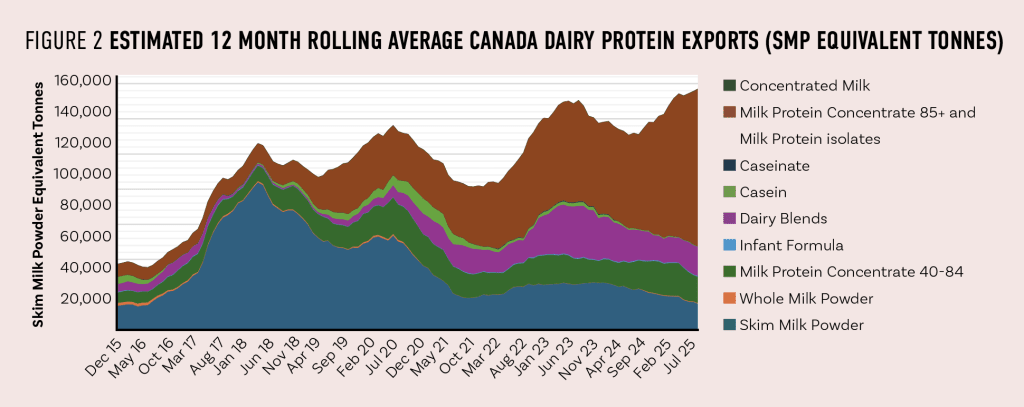
DCANZ analysis (Figure 2) has converted Canadian exports to milk protein equivalent volumes to illustrate the rapid expansion of exports as skim milk powder exports from 2015-2018, and then the shift of these volumes to other products as the US sought to limit skim milk powder exports.
“We’ve seen that protein shift from being in skim milk powder to being in milk protein concentrates, or skim milk powder blends, or milk protein isolates,” Kimberly explains. “We’re now seeing increased volumes of protein coming onto the global market and causing distortion in products that our industry has invested in to add value to our milk.”
In other words, the distortion hasn’t gone away – it has ‘moved and morphed’, following the incentives built into Canada’s domestic regime.
Concerningly for the New Zealand industry, this shift in Canada’s international market disposal of its protein surplus is occurring into products which are a focus for New Zealand exporters to add value to and grow New Zealand export returns. MPCs and MPIs are a proud part of New Zealand’s dairy innovation story, the technology for these products was pioneered in Palmerston North for supply to sports and medical nutrition applications.
Kimberly also highlights a serious threat of growing disruption, with Canada’s SNF surplus forecast to grow. The Canadian Dairy Commission reported a structural surplus of over 129,000MT in 2020-21, which grew to 153,000MT in 2023 and is estimated to grow to 211,000MT by 2029-3030.
Risk to the NZ industry
A Business Council of Canada manufacturing member published comments in January 2026 in The Financial Times that read “New Zealand’s elimination of protectionist strategies in its dairy industry decades ago has today seen it as the world’s largest dairy export business. Tiny New Zealand is the biggest dairy exporter in the world. That could be Canada, with highly efficient farms making amazing products for the world.”
There is up to a billion dollars of high-value protein exports to the United States at risk of value erosion along with other products and markets. DCANZ has fed information to officials for the past 12 months about the damage being caused to NZ exporters by the policies and has estimated there to be potential for $257 million per annum to be lost in added-value returns for New Zealand exporters if Canada continues with its current policy. DCANZ highlighted the “increasingly urgent” problems developing in global markets due to Canadian milk pricing policies in an August 2024 letter to Trade Minister, Todd McClay. They have asked for a formal WTO case against Canada and are urging the New Zealand Government to be timely in its action.
“Canada is pushing these products out into the market with subsidies – effectively dumping them at artificial prices into other markets,” Kimberly says. “The US has been the main market those products have gone into, and that’s a really significant market for us.”
The result is unfair competition right where New Zealand has been investing heavily – ‘value-added protein products’.
The 2025 15% tariff differential that NZ products now face compared to Canadian exports into the US market has compounded the risk since DCANZ’ initial analysis.
The US is our second-largest market for dairy protein products and it is also the market bearing the brunt of Canada’s subsidised exports.
“Our companies are facing undercut prices driven not by efficiency or innovation, but by policy-driven surpluses.”
Rules-based system only good if it’s actively used
DCANZ believes there is a case to be taken via the WTO to once again pull Canada into line with its trade obligations and commitments. While the WTO is facing challenges in fully resolving trade disputes between some parties due to an inactive Appellate Body, both New Zealand and Canada are members of an alternative appeals arrangement, which removes this challenge.
“DCANZ has always valued New Zealand’s active engagement in the rules-based trading system because it offers the process to resolve the legality of current practices; it is important that we keep using it”.
New Zealand isn’t alone in its worry
The US dairy industry and the Australian industry share DCANZ’s concerns about Canada’s behaviour and have also raised the issue with their respective governments.
In response, the US Government has launched an International Trade Commission (ITC) investigation into what Canada is doing and how it is affecting markets. The resulting investigation report is expected to be a key input for the United States Trade Representative, as the USMCA agreement is reviewed this year.
DCANZ has taken the opportunity, alongside its US counterparts, to share its understanding of Canada’s distortion of markets.
“ We’ve put in two tranches of submissions. Their investigators have interviewed New Zealand industry participants about what we’re experiencing in the market, and we’ve also testified in front of the International Trade Commission in Washington.”
But DCANZ does not see the US focus as a substitute for New Zealand action.
“The USMCA renegotiation is an avenue available to the US to seek changes from Canada but it won’t necessarily remove the risks New Zealand exporters face globally” Kimberly says. “We also need New Zealand to enforce the WTO rules, to ensure any changes Canada makes are ones that will solve the issues for New Zealand exporters.”
Pain is sharper in a down cycle
Trade distortions are always harmful, but they become particularly acute when global markets are under pressure.
“We always feel other countries’ trade distortions more acutely when we’re on the downside of the commodity cycle,” she notes.
At a time of tougher international conditions, increasing use of subsidies in other countries, and heightened geopolitical risk, New Zealand’s exposure as a small, export-dependent dairy nation is clear. For DCANZ, that only strengthens the case for moving from quiet concern to formal action.
“If Canada wants to manage its system and insulate itself from the global market, then do it fully,” Kimberly says. “But don’t ask our farmers and our exporters to pay the cost of their choices.”