Real data shows real costs
A deep dive into the numbers shows just how big the dollar benefit is to utilising pasture well and reveals the surprising real cost of supplement boosted milk production. Words Anne Lee.
How much money are you really making out of the extra milk production produced on the back of supplements?
Based on Taranaki data, that additional milk could be costing you more than the forecast milk price, depending on how well you’re utilising pasture.
Prime Minister’s chief science advisor, Dr John Roche, who works for the Ministry for Primary Industries, gave farmers a timely 101 at the 2025 Pasture Summit field day on understanding marginal cost of milk production in Taranaki during the summer. His presentation to the Pasture Summit field day was backed by his detailed analysis using substitution rate equations developed by Australian scientist Dr Richard Stockdale and data collected by DairyNZ’s DairyBase.
John showed that in almost all situations, cows fed supplements eat less pasture and the substitution rates vary across season as well as by pasture drymatter (DM) intake and the amount of supplement fed.
“The more pasture you feed, the greater the substitution rate and the lower the response to supplements. Likewise, the more supplements you feed, the greater the substitution rate and the lower the response to the supplement,” John says.
“In a situation where cows are being fed 10kg DM/day of pasture (in a bad spring) and supplements are being fed at 5kg DM/cow/day, the substitution rate is about 40%,” he says.
“That means their total DM intake is only increasing by 60%, so you’re feeding them 5kg DM/day of supplement, they’re only eating about an additional 3kg DM total, and the response to that supplement in spring is, on average, 53 grams milksolids (MS) for a kg of supplement.”
“Averaging operating expenditure hides unprofitable milk.” – John Roche, Prime Minister’s Chief Science Adviser
Substitution rates are higher in spring than they are in summer and higher in summer than they are in autumn.
“The double whammy of those high spring substitution rates is that the cow is substituting ‘high quality pasture’ whereas in summer and autumn, pasture quality is not always as high. So, our best response to supplement is going to come in autumn.
“That’s not to say there aren’t times when you need to supplement in spring, but just be aware of what’s going on,” he says.
Another important piece of information is in understanding the marginal cost of additional milk and the impact of poor pasture utilisation on the economics of supplements.
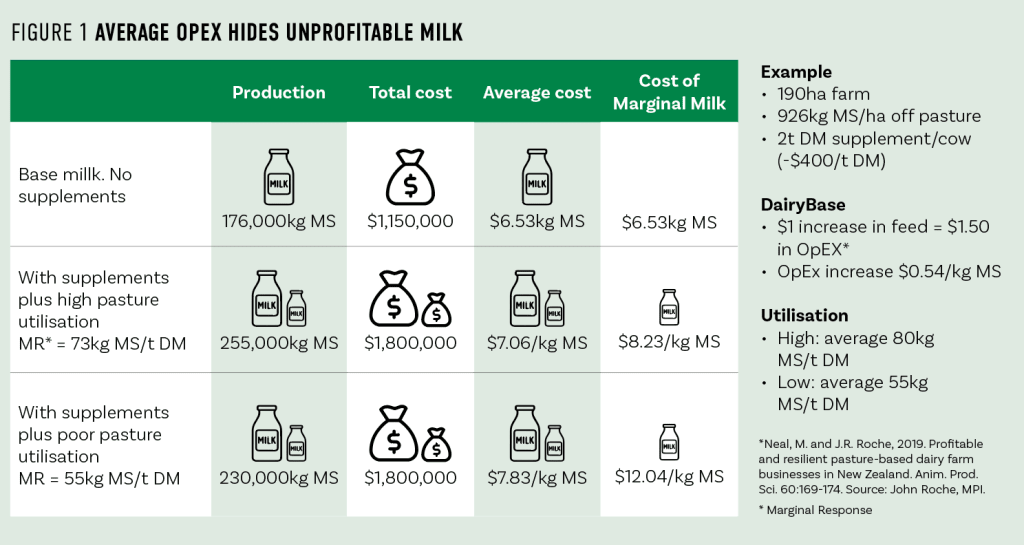
He used Taranaki DairyBase data and an example farm to first show the average cost of increasing milk production with supplement and good or poor pasture utilisation (see Figure 1).
Base scenario: 190ha farm producing 926kg MS/ha from pasture alone, no supplements. Total production: 176,000kg MS. Total costs: $1,150,000 or $6.53/kg MS.
Scenario two: Supplement with high pasture utilisation. 2t DM/cow of $400/t DM supplement fed. Total production: lifted to 255,000kg MS. Total costs: $1,800,000 or $7.06/kg MS.
Scenario three: Supplement with low pasture utilisation. 2t DM/cow of $400 /t DM supplement fed. Total production: lifted to 230,000kg MS. Total costs: $1,800,000 or $7.83/kg MS.
“Averaging operating expenditure hides unprofitable milk,” he says.
The true cost of the extra milk in scenario two is $8.23/kg MS and for scenario three is $12.04/kg MS.
Marginal cost
The change in total cost/change in milk output

The marginal cost analysis formula reveals that the true cost of the additional milk for the high utilisation scenario two was $8.23/kg MS.
“If pasture utilisation is low – and that scenario isn’t as low as what we can see on farms, believe me, the cost of that additional milk is even more expensive, at $12.04/kg MS because of the lower response rate to supplements.”
More detailed analysis using experimental bio-physical data in response to supplements and real financial data from DairyBase showed supplement and milk prices where it can be profitable to use supplements to fill feed deficits, providing good pasture utilisation is achieved.
But if you want to use a supplement to lift stocking rate, even at a supplement cost of $200 – $250/t DM, milk price must be above $9.50-$10/kg MS before it’s profitable.
“If you’re not getting great responses to supplements, so poor pasture utilisation, there is almost no situation where it’s profitable. We have to be up at milk prices of $11 – $12/kg MS and supplement prices at $200-$250/tonne to be using supplements to drive up our stocking rate.”