Tools for growth
Creating significant wealth and building equity in the dairy sector is not just a possibility, it’s exciting and achievable with a clear strategy, disciplined action and an understanding of some basic principles. Paul Bird (DairyNZ) and Lynaire Ryan (Agribusiness Education) join forces to outline* Steps to Wealth Creation in the New Zealand Dairy Industry. Words Lynaire Ryan & Paul Bird.
Dairy farming in New Zealand still offers a clear and achievable pathway to wealth creation, just as it has for decades, but that doesn’t mean it will just happen.
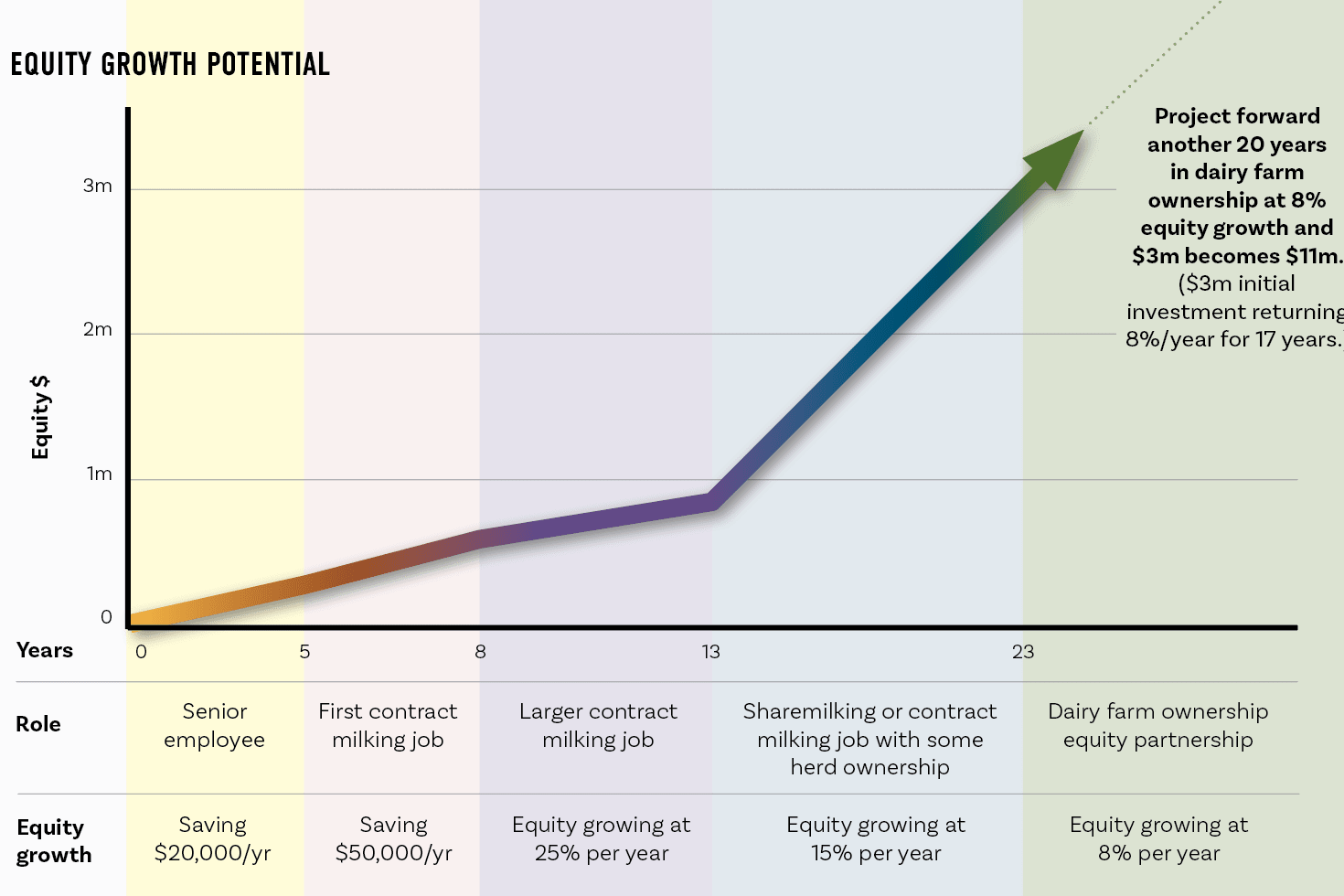
It requires understanding the fundamentals of saving to build a pool of money, developing farming and financial skills, investing wisely and one of the most powerful forces in finance – compounding. The opportunity allows wonderful progression through the stages from working as farm staff to farm ownership. Potential equity growth starts for many by moving from an employee making savings, through contract milking, and then growing the business through herd ownership. A range of business combinations are now being used. For instance, a farm manager or contract milker may also own cows which they are leasing into a herd. Sharemilkers may be in an equity partnership in their sharemilking arrangement and a contract milker might retain their contract milking job while also investing into an equity partnership in a dairy farm. The essential skill now is to learn how to evaluate any opportunity. Knowing we see a range in returns in sharemilking, leasing and farm ownership, we need to be sure that we choose an investment opportunity that is at least performing in the top half of the industry.
Saving and Investing: The Power of saving over time
Compounding is one of the most powerful forces in wealth creation.
It works because your money earns returns, and those returns, when reinvested with the original sum, start earning money too. Over time, this creates exponential growth rather than linear growth. Albert Einstein famously referred to compounding as the 8th wonder because of its ability to turn modest, consistent investments into substantial wealth, given enough time and a reasonable rate of return.
The Two Key Drivers: Time and Rate of Return
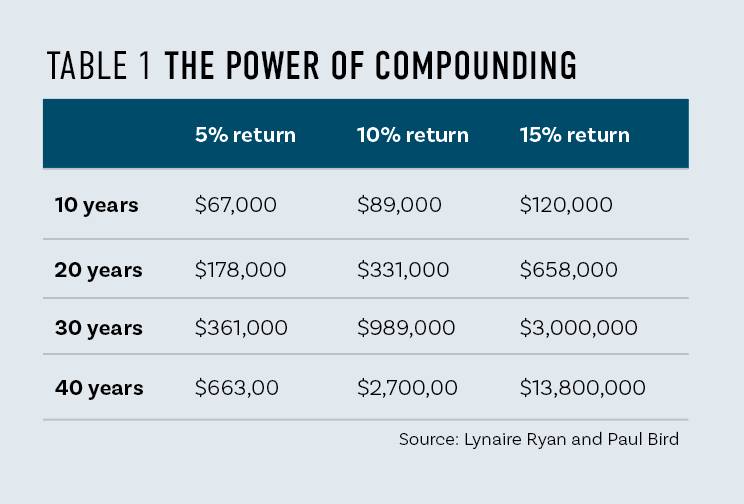
Table one shows the impact of time and rate of return on simply saving $100 per week.
Time
The longer your money stays invested in passive or active investments, the more cycles of compounding occur. Even small contributions can grow dramatically over decades because each year’s gains add to the principal for the next year so your investment is earning returns on a greater and greater amount.
If a person saves $100 per week throughout their working lifetime, and invests it at a 10% return, their investment would grow into a $2.7million nest egg. Now that is exciting and puts a real drive into the wealth creation plan.
If we could encourage our children, our staff, ourselves, to save an extra $100 a week or $5200 a year, these become million-dollar decisions over a lifetime. This shows the massive impact of consistent savings and compounding over time.
Because compounding rewards patience and discipline, you don’t need to invent anything or take extreme risks – just invest consistently and let time do the heavy lifting. The earlier you start, the more powerful the effect becomes.
“Consistently good returns over time give extraordinary results.”
To calculate these compounding numbers for yourself we suggest using the Compound Interest Calculator at thecalculatorsite.com
Profit: Rate of return
The profit you can drive from your business has a major impact on your long-term wealth creation because it is effectively the rate of return.
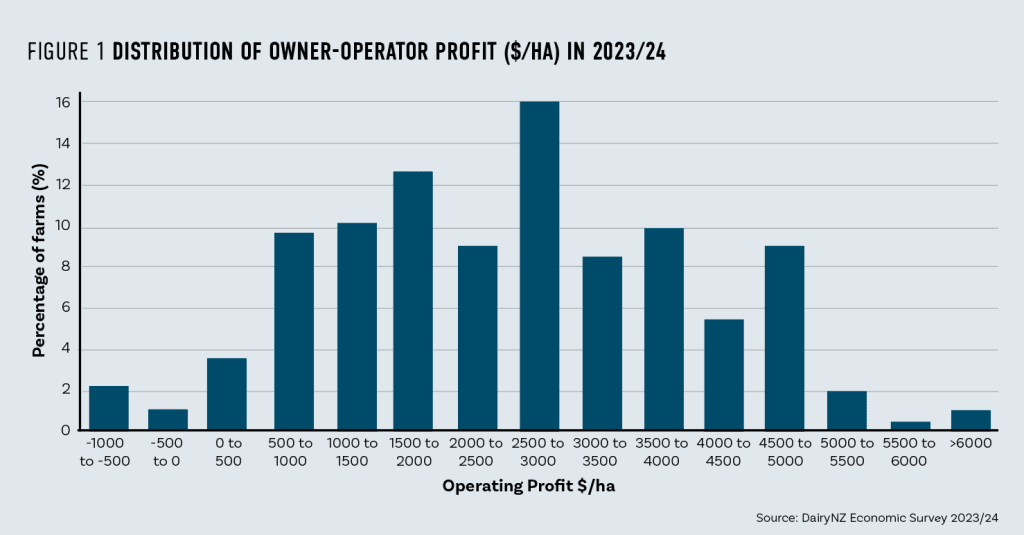
There is a huge range in the profitability of farm business owners. Whether people are farm owners, herd owning sharemilkers or contract milkers, there are some driving a strong profit from their business, while others are making very little profit and return on their dairy assets. (see Figures 1 and 2). Making the effort to ensure you are in the top half of performance has a huge impact. Master the skills needed to drive those strong profits because those returns, along with mental fortitude, allow businesses to withstand the cyclical nature of the dairy industry. Strong profits provide the buffer to weather the financial storms.
Understand the key principles of a highly successful pasture-based system – focus on profit by maximising pasture growth and utilisation by cows of high genetic merit along with strong cost control.
Get exceptionally good at budgeting – create an annual budget and a monthly cash flow plan and review these regularly.
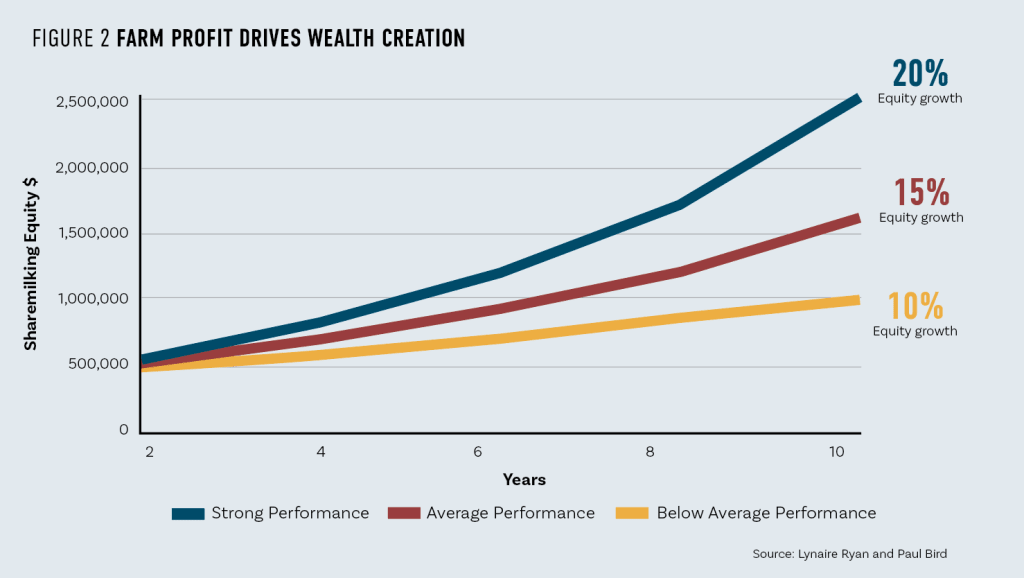
Figure two shows the impact of rate of return on equity growth over a 10-year period. The difference between a 10 and 20% rate of return is $1.5m. In reality, the returns for sharemilkers have been several percent higher than this in recent years, due to strong dairy markets. But added to the cyclical nature of milk prices, there is also huge range in performance. Exceptional sharemilkers show returns of 30 – 40% per annum, while others may not run a profitable business.
This same wide range of profitability occurs with contract milking. (Figure three). A number of contract milkers are generating three to four times the profit of the average contract milker.
DairyBase data shows that for the 2023/24 season, the average contract milker grew their equity by a healthy $42,000, while the top 50% grew their equity by an even more impressive $73,000.
Herd Ownership: Magnify your returns with sensible borrowing
If you can find an investment where the rate of return is consistently greater than the interest rate, then it might be a great idea to borrow money to invest. Then you have a bigger pool of money at work for you. This principle is commonly used in the New Zealand dairy industry.
For example, a sharemilker has $800,000 invested in 300 cows, replacement heifers, plant and machinery. The sharemilker has the opportunity to borrow to buy a further 150 or 300 cows or remain at 300 cows with no borrowings. Table two compares the returns from these three scenarios.
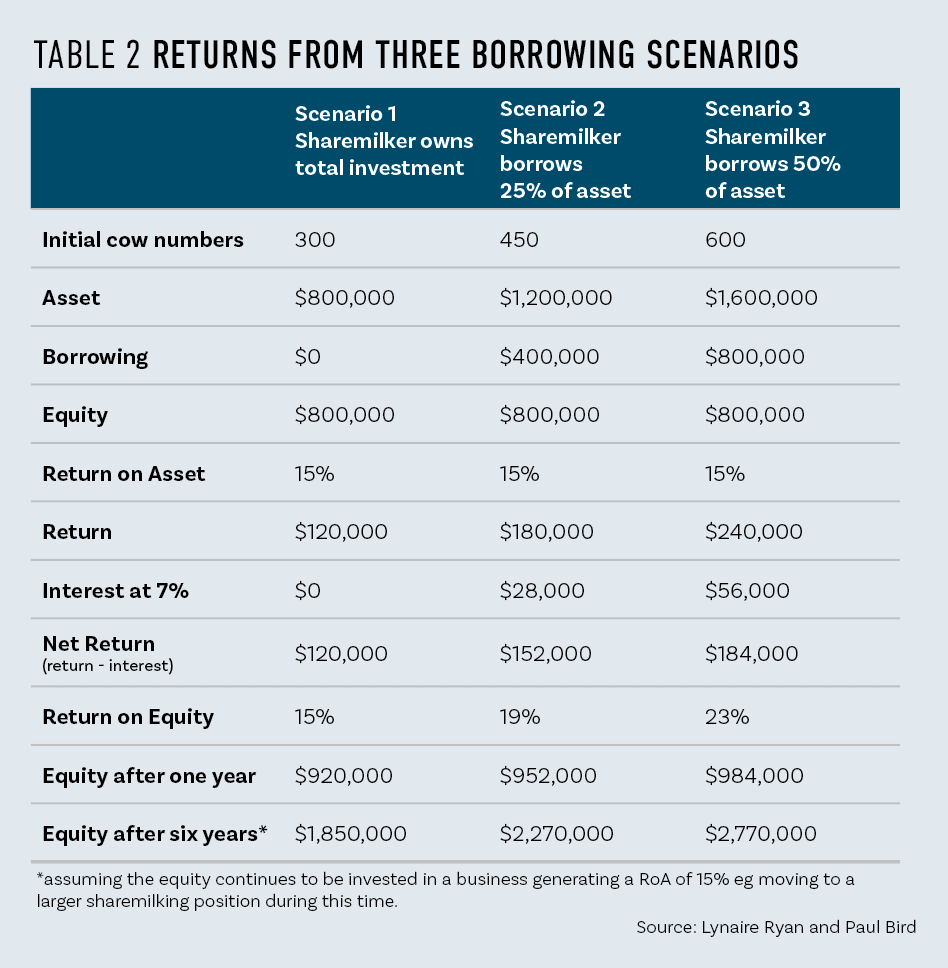
Notice how return on equity increases as the level of borrowing increases. The table shows the equity after one year and after 6 years, being two 3-year-long contracts. Please don’t get distracted on our estimates of cow values – these have been volatile over recent years – just look at the concept, not whether we have “guestimated” cow value correctly.
From these scenarios you can see you can leverage up or magnify your returns if you have a greater pool of money invested and at work for you. But beware, this only happens when the return on asset is greater than the interest rate on the borrowed money. If your return on asset is less than the interest rate – i.e. you pay more to borrow the money than your investment is returning, then you will magnify the losses as well. Borrowing accentuates the gains or losses made.
*This information is provided on an educational basis. Every individual should seek their own professional financial advice before making investment decisions
How to calculate your growth in equity
One of the most enlightening and empowering figures to calculate is your growth in equity percentage. In the business world, this is called your CAGR% or compound annual growth rate. A practical way to calculate this is to go from your equity today back to when you had your first $100,000 in equity.
Step 1. Calculate your equity today.
Assets ($) – Liabilities ($) = Equity ($) For example: $800,000 – $220,000 = $580,000
Step 2. First significant investment
Work out how many years it is since you had your first significant equity investment of $100,000 equity or more, remembering that equity is assets minus liabilities.
For example: Eight years ago you had $200,000 assets and $80,000 debt so $120,000 equity.
Step 3. Calculate the CAGR%
The formula to calculate CAGR% can be done on a calculator but looks a bit complex.
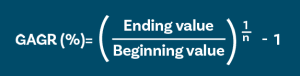
You can use AI (ChatGPT or Gemini for instance) or one of many online CAGR calculators to find the answer. In the example case the CAGR is 21.8%.
This is a good key performance indicator (KPI) to use over a period of years. It measures how your equity has grown after you have made a profit from the business, paid interest, taxes and drawings and takes into account capital gains or losses. We have observed good farm owners achieving a CAGR% of 10-15% over a 20-year period, and sharemilkers 20-25% over a 10-year period. This can also be a useful figure to project forward with to make a guestimate of equity in the future.
For example, if a farm owner had achieved a 15% CAGR over a 20-year period, we would compound today’s equity forward for another 10 to 20 years, at a more conservative rate (5 and 10%) to estimate the future financial position. This then allows us to ask strategic questions such as – What might the business look like then? Do we have the skills in place to run such a business? What would we like it to look like? Can this help us shape succession plans and retirement?
Reputation equity
Reputation as a Formula
Reputation is one of your most valuable assets.
Reputation = (Skill x Reliability) + visibility
Skill shows you know what you’re doing, and reliability proves people can count on you. But even if you score high on both, it won’t matter if nobody knows you. Building a reputation means combining competence with visibility – letting others see your work and character.
Getting Connected
Opportunities in farming often come through relationships. You don’t need to be an extrovert, but some gentle effort is essential – attending field days, introducing yourself to farmers you admire, or reaching out to learn from someone experienced. Most farmers are generous with their knowledge. Staying isolated limits your chances to grow.
The Compounding Effect of Reputation and Skills
Skill and reputation can compound too. Every day you focus on getting a little better – learning from the best, refining your habits – you’re adding to your “reputation equity.” Over years, these small improvements and connections multiply. Surround yourself with good farmers and good people because habits are contagious. Steady growth in skill, trust and opportunities, all built on consistent effort and the right relationships – you’ll be amazed where you can get to.