Discipline needed against uncertain backdrop
Tighter margins are expected for the current dairy season despite a strong milk price forecast, with global uncertainty and higher input costs creating pressure. Words Emma Higgins.

The 2025/26 season was an exceptionally profitable one for New Zealand’s dairy producers, featuring broad-based strength across dairy commodities alongside strong capital returns and dividends for Fonterra suppliers.
Against this backdrop, the dairy sector kicked off the 2026/27 season on extraordinarily solid foundations, with this further reinforced by Fonterra’s strong opening milk price forecast of $9.75/kg milksolids (MS). However, by mid-July, the shine had been taken off the solid start, with a downward revision of the milk price by 50c to 9.25/kg MS.
While this forecast remains broadly profitable for dairy farmers, the inflationary impacts of geopolitical disruption are likely to further squeeze farmer margins over the course of the season, and disciplined cost control and scenario planning will be essential.
The conflict in the Middle East and resulting near four-month closure of the Strait of Hormuz, from early March through to mid-June, created conditions reminiscent of past stagflationary shocks. The initial impacts of this led to higher prices for key upstream dairy inputs, including diesel, fertiliser and industrial goods, while second-round effects also emerged, with elevated energy costs feeding into broader inflation expectations.
The signing of a memorandum of understanding (MoU) between the US and Iran on June 17 has seen some relief for oil, freight and fertiliser prices, however RaboResearch remains sceptical that the MoU will lead to a lasting peace agreement that resolves all points of disagreement over the nuclear programme and Iran’s backing of Hezbollah in Lebanon.
At the time of penning this article, tensions are beginning to mount once again and any further closures of the Strait of Hormuz could increase pressure on farm input costs.
Kiwi farmers continue to navigate a volatile global landscape, while domestic borrowing costs appear poised to increase, this all underscores the need for farmers to undertake wider-than-usual scenario planning across both costs and revenues.
Fundamentals influencing commodity prices
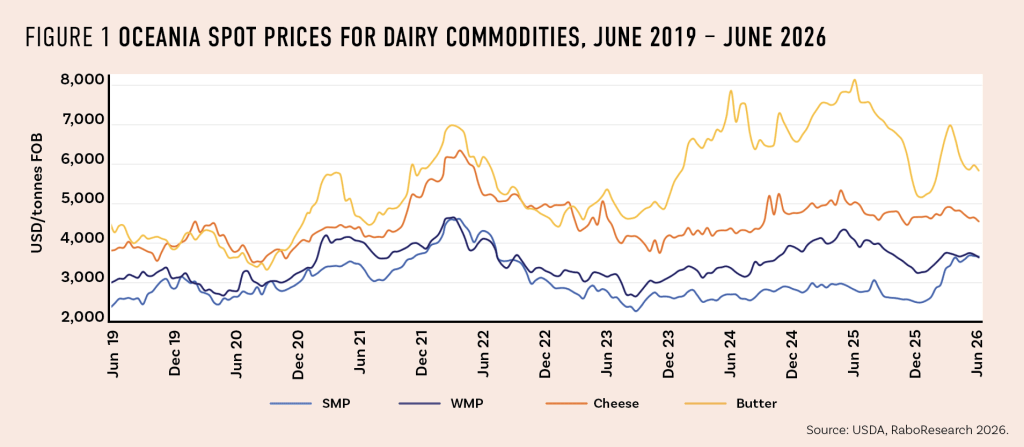
The dairy commodity complex weakened in July 2026 with declines recorded across all products. Whole milk powder was the weakest performer, falling approximately 4% compared to the month prior. This continues the broader softening trend across the commodity basket which has persisted since prices peaked in March 2026 and is likely the core reason for the 2026/27 milk price forecast downgrade.
Commodity prices are reflecting ample milk supplies. In the US, milk production continues to outpace last year, with May volumes 2.3% higher year-on-year. Growth in key producing states – including California, Wisconsin and Texas – has supported overall supply. High beef prices are also incentivising extended lactation. Cow numbers in May increased by 10,000 head month-on-month and were up 184,000 head compared to May 2025, while yields also improved year-on-year.
Closer to home, New Zealand milk flows reached record levels for the 2025/26 season with 2.02 billion kg MS produced. Milksolids production increased 4.5% compared to 2024/25, with 10 of the 12 months setting new monthly records.
Across the Tasman, Australian milk production has been broadly flat over the first 11 months of the 2025/26 season through May.
Milk production in the European Union has started the year strongly. However, growth is beginning to slow. April production increased 2.3% year-on-year, marking the slowest growth rate since July 2025, driven by the comparison with strong production in April 2025 and softer milk prices.
Germany recorded strong growth in April with weekly data suggesting this momentum has continued through to the first week of June 2026. In contrast, Ireland’s milk production declined by 3.5% year-on-year in April – the first monthly decrease of the calendar year. This is ahead of any potential impacts from recent heatwave conditions, which could further weigh on milk yields.
France reported milk production volumes 5.3% higher year-on-year in March 2026, supported by a stronger and earlier spring peak compared to 2025. However, this trend has since reversed, with output slowing to 1.2% in April year-on-year and below 2025 levels by early May.
RaboResearch anticipates EU supply to contract in quarter three 2026. The heatwave across the EU is likely to have placed additional pressure on production, potentially accelerating the anticipated slowdown in growth.
On a full-year basis, global milk production is estimated to rise 1% in 2026 and decline slightly in 2027, supporting a rebalancing of global milk supplies after several quarters of strong growth.
New Zealand supply key factor in local milk price
The elevated milk supply in the 2025/26 New Zealand dairy season is expected to carry into the new season and shapes as a key determinant in pricing for Oceania dairy products over the months ahead.
Based on current fundamentals, New Zealand milk production in the 2026/27 season has potential to modestly increase by up to 1%. But, as always, weather conditions – particularly the risk of a developing El Niño – will play a role in shaping the final outcome.
This season may signal the beginning of a new structural phase for New Zealand milk production, characterised by a higher baseline level of output. Since 2014, production has largely oscillated within a relatively narrow band, however, the performance of the 2025/26 season suggests the industry may be breaking out of this range.
Disclaimer – The information and opinions contained in this article are indicative and for discussion purposes only.