Reynolds’ RAT – Where are you sitting?
A new model may best describe the spread in farm business performance. Positioning yourself well on the rodent-shape could be more vital than you think. Words Richard Reynolds.
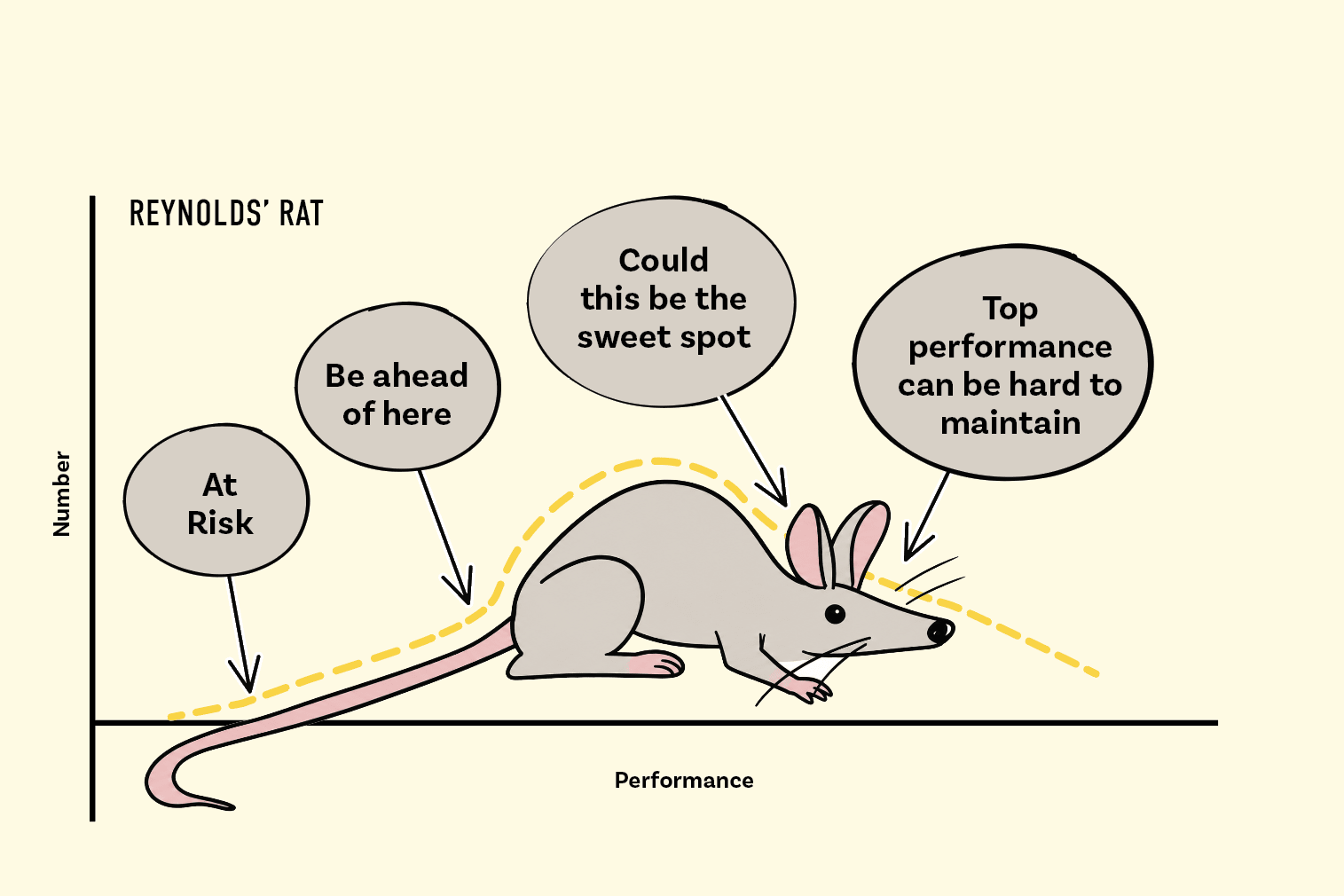
I’m going to blow your mind. The bell-shaped curve they taught you at school, more often than not, is wrong; it is rat shaped. A small pointy nose going in a new direction, a big body and a long tail dragging behind.
In dairying, this rat-shaped graph works for all aspects of farming and your personal life. In reproductive performance for example, you have farmers annually achieving a sub 5% empty rate making up the pointy nose. Most farms lie in the 10-12% empty rate, or the body, and then the long tail from 20-30%, empty.
Now that you have the Reynolds’ Rat Graph in your head, you can see how it works for all aspects of farming including pasture management, production, time off-farm and financial results. Based on my experience as a farmer and farm consultant, as well as my brother Robbie’s insights as an accountant, the Rat can be a much more apt representation of financial performance across farming.
“During hard seasons, the rat’s tail gets longer, they get skinnier and they are desperate for food from their friend the banker.” – Richard Reynolds, West Coast
While we’re currently basking in the good times with record payouts, capital return from Fonterra and high milk flows throughout New Zealand, staying alert to the factors that extend the tail is no less important. The memory of farming through Westland Milk Product’s $8/kg milksolids (MS) payout followed by its clawback to a $3.99/kg MS payout the following year hasn’t faded. The good times don’t last forever.
Characteristics of the rat model
Things that we notice about those sitting at the high performance, wet nose end of the rat:
- Strong engagement in industry
- Knowledge lust
- Clear aims
- Age
- Clear farming approach
Over the short to medium term, we see the same farmers at the pointy nose of the rat and we see the same people behind the anus. But over time, with changes in energy levels for the business, we tend to see these top performers fall back on the rat to sit at the ears where there are fewer demands to keep pushing the farming system.
“Those on the tail are forced to look backwards and the climb up to the body seems perilously steep. They may have to swallow some unpleasant realities to move up.” – Richard Reynolds, West Coast
This works well as they have strong balance sheets and well-established farming systems. They’re looking forward comfortably with foresight rather than sitting at the end that’s furiously sniffing out the next move.
For those sitting at the tail end, behind the anus, life can be risky and unpleasant. They risk getting caught in the trap unintentionally. Banks are less inclined to feed the tail. Those on the tail are forced to look backwards and the climb up to the body seems perilously steep. They may have to swallow some unpleasant realities to move up.
The individual rat
The rat is a useful analogy as a descriptor of individuals too. In good seasons, rats get fatter and have shorter tails. Have some sympathy next time you see a bank manager. Farmers being profitable and Fonterra helping drop farm debt from from $22/kg MS to $16.50/kg MS doesn’t create good weather for a bank, and they are trying to feed any rat that they can. Remember though, the fat rat doesn’t have to take the food the banker is offering.
During hard seasons, the rat’s tail gets longer, they get skinnier and they are desperate for food from their friend the banker.
For all you grey haired rats out there – at 65 you get a weekly income. How much do you need to pay the bank?
In NZ, at retirement, if you have a debt free house and earn $40,000/year after tax plus super, you are in the top 12% of the 65-plus age group. If staying on the farm is the most enjoyable location for you, how does the farm need to be set up to achieve your goals – maybe you need to slide down the rat a bit?
High payout years give farmers opportunities to leave the industry in a timely and profitable manner. Coming from the West Coast, I have seen a period when there were very limited farm sales for a period of seven years, not so now.
If you’re sitting up high, just behind the ears, and you’re finally feeling like you’re a nice fat specimen, maybe it’s time to leave the ship – albeit that it’s sailing in fair winds not sinking.
Click here to watch Richard talk about The Rat performance model on CountryWide Connect.