Livestock valuations and your tax bill
Choosing which livestock valuation scheme you use can have an impact on your tax obligations. Recent high cow prices mean if you’ve bought cows this year, the choice could be even more important. Words Trudi Ballantyne.
If this is your first year as a sharemilker, you are likely to have paid a high price for your cows. When it comes to completing your financial statements for the 2025/2026 year, a decision will need to be made about which livestock scheme to value your cows under.
The way in which livestock is valued can have a big impact on how your taxable income is calculated – so it is something that every farmer needs to try and understand.
When it comes to calculating how much taxable income you have made from livestock trading, there are two parts to the calculation. The first is the difference between the livestock you sold, less what you purchased. This part of the calculation is easy – it is based on your bank transactions.
The next part is the difference between your opening and closing livestock. Your accountant will start by completing a reconciliation of your numbers. Once the reconciliation is completed, the closing stock needs to be valued.
While there are several options available to value your stock, there are two main schemes which most people use: National Standard Cost (NSC) and Herd scheme (also called National Average Market Value scheme).
“The way in which livestock is valued can have a big impact on how your taxable income is calculated – so it is something that every farmer needs to try and understand.” – Trudi Ballantyne, Stem Rural
NSC
Under the NSC scheme, purchased animals generally start at their purchase cost, but the valuation for home-bred replacements is a little more complex. Each February, IRD issues a determination for the value of each livestock category based on its analysis of the costs to rear them. This year it determined the value of a rising one-year-old (R1) dairy animal as $788.90 and added a further $535.50 for an R2. If you haven’t purchased any livestock during the year, your R1 animals will be valued at $788.90. If you have bought stock then the closing value will be a weighted average of the purchase price and those animals you have reared.
Under the NSC, your stock are recorded at a value lower than market value so when you sell them, tax is generally payable on the difference between the sale price and the tax book value. While the NHC is more flexible than the Herd Scheme, timing and tax consequences of changing methods still need to be considered carefully.
Herd scheme
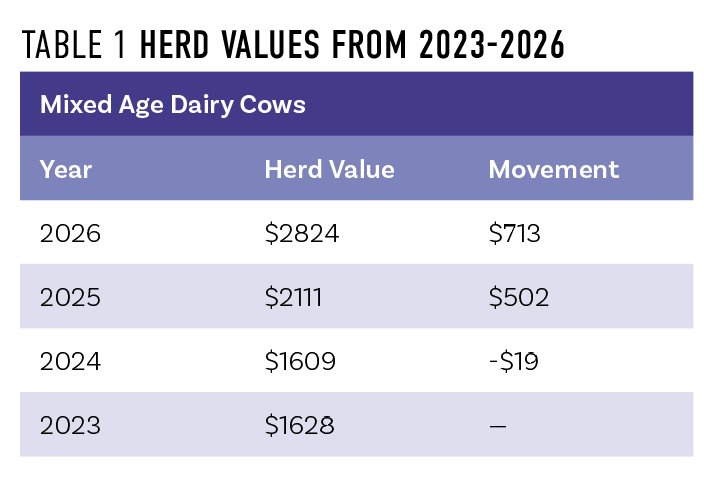
Each year in April, IRD surveys livestock agents throughout the country and determines what the “National Average Market Value” is for each class and category of livestock. Mixed-age dairy cows in 2026 were $2824. This compares to $2111 in 2025, an increase of $713 per head.
When you use the Herd Scheme, the change in the per head value each year is not treated as taxable income. So, for anyone using the Herd Scheme in 2025 and 2026, there will be a tax-free write up of $713 per mixed age dairy cow. Conversely, when values drop, the write-down is not tax deductible. Tax payable on the sale of a herd under the Herd Scheme isn’t likely to come as such a surprise compared to what may be owing for those using NSC. Once in the Herd Scheme, it is much harder to get out, but if you’re increasing numbers, you can use a combination of the schemes.
One of the best ways to illustrate the options available to a farmer that has recently purchased stock is to use an example. Let’s assume a farmer has the following livestock on hand at 31 May 2026, all purchased during the year.
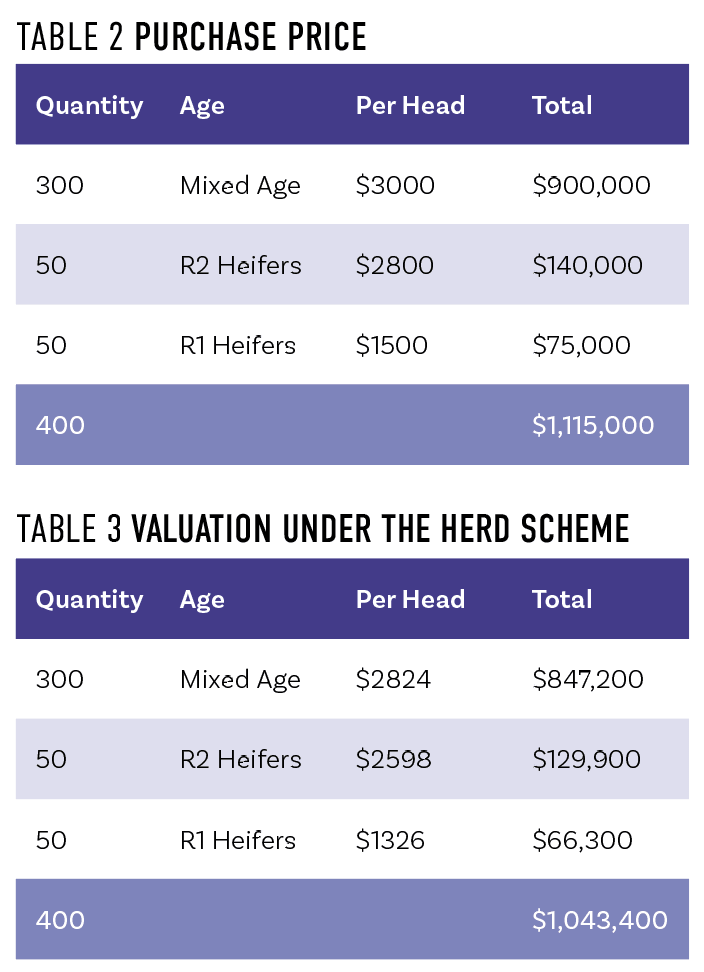
This would result in a write-down for tax purposes of $71,600 (the cost price less the valuation). This would mean that the farmer is now in the Herd scheme and will have to continue valuing all dairy stock using the Herd scheme in the future.
If the cow values drop in 2027, any reduction in values will not be tax deductible. It will also mean that when the farmer comes to sell his stock, the amount of tax payable on sale will be minimal as the book value of the stock will be close to sale price.
The other option for our new livestock owning farmer is to value the stock using the NSC method. Under this method, the stock on hand at 31 May 2026 would be valued at $1,115,000 – i.e. what he paid for it. There would be no immediate write down for tax purposes.
For NSC purposes, the mature livestock group is averaged, which is why the mixed-age cows and R2 heifers do not continue to show at their individual purchase prices.
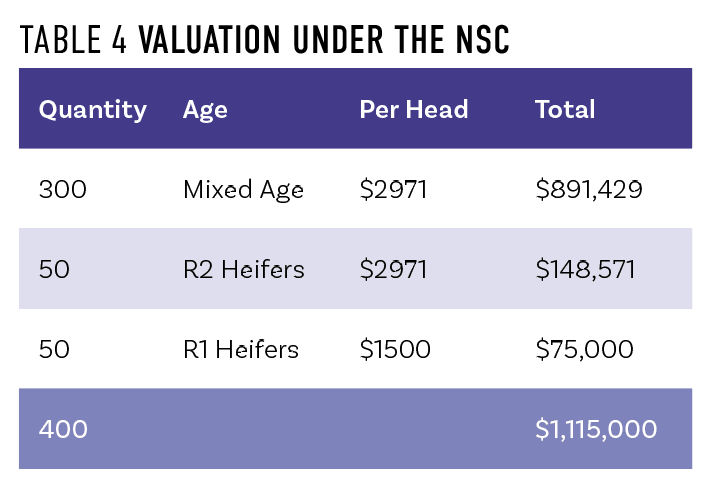
If the farmer continues to use NSC moving forward, and assuming the same stock numbers on hand at 31 May 2027 (i.e. 50 births and 50 sales), the closing stock values would be as shown in table five (*assuming the 2027 NSC values are the same as 2026).
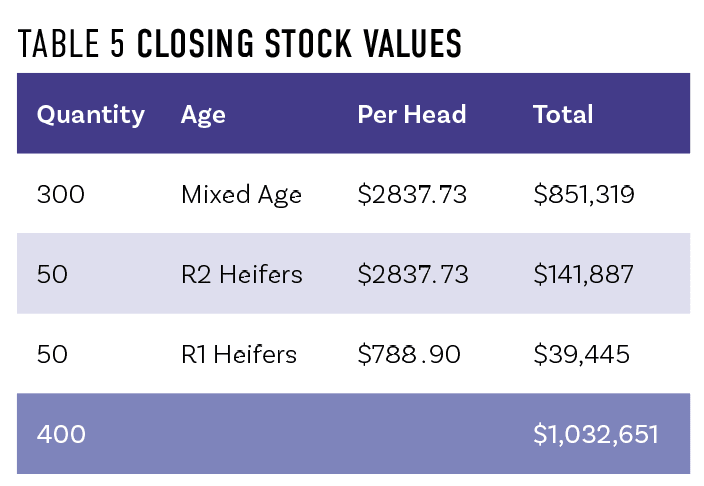
In that 2027 year, there would be a tax write-down of $82,350 – with the per head value of the mature livestock group gradually reducing. This reduction and write-down would continue over the next few years until the per head value of the mature cattle group got to about $1324 (being the R1 NSC value of $788.90 + the R2 NSC value of $535.50).
If the farmer were to sell his entire herd while he is on NSC, he will probably end up with a tax bill, as the sale price will be higher than the book value.
If, in the 2027 year, the Herd livestock values drop from the highs of 2026, the farmer could opt to jump into the Herd scheme at that point. To do this, you do have to notify IRD that you are electing to value your livestock using the Herd scheme – as would the farmer who opted in in the earlier example. By doing this later election in 2027, the farmer may benefit from the drop in values. However, this is not a decision to make based on one year’s tax result alone – once in the Herd Scheme, it is very difficult to move out again.
Recommendation
Livestock valuation is complicated. There are many options available and every person’s circumstances are different. Make sure you have an accountant that understands both schemes described above and knows the rules about moving between the schemes. Talk to your accountant about what your longer-term intentions are, as this may be a factor in deciding which scheme is right for you.