From burnout to balance
West Coast/Top of the South Sharefarmers of the Year are no strangers to hard work and determination. But they’re no strangers to burnout and mental health challenges either. They understand only too well the importance of work-life balance and walk that tightrope of high achievement and wellbeing on the daily. Woeds Anee Lee, Photos Kelsey McKenzie.
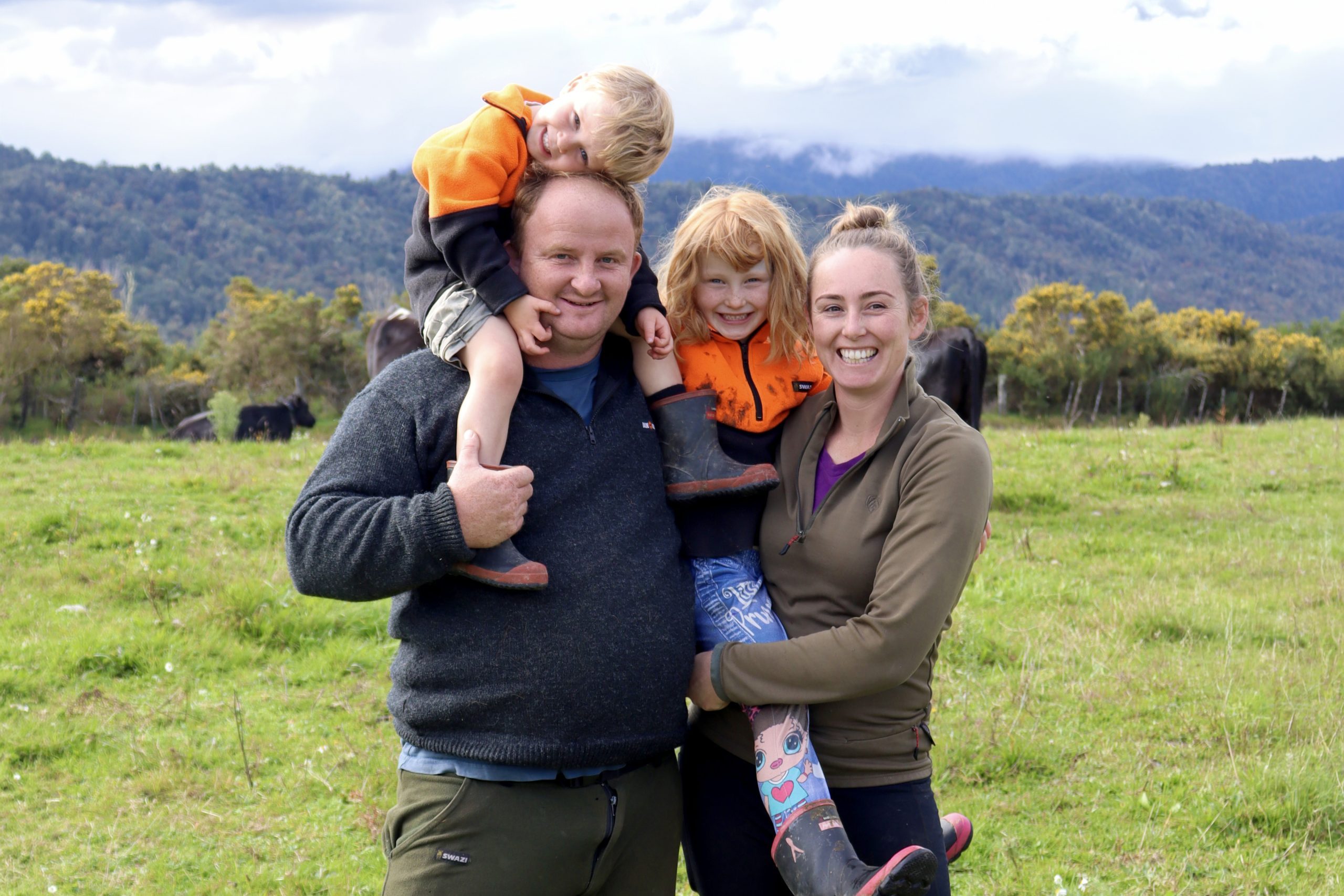
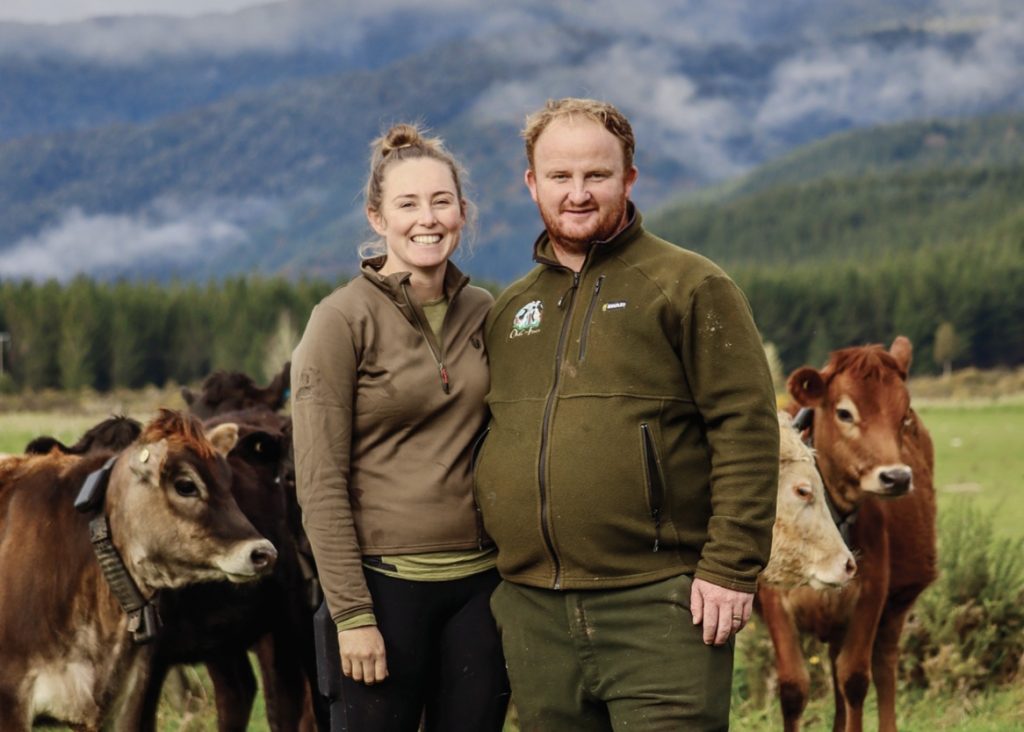
Abbi Ayre and Frikkie Terblanche are high achievers. A slew of awards and the top title for their region at this year’s New Zealand Dairy Industry Awards are testament to that.
As well as the Sharefarmer of the Year for West Coast/Top of the South, the couple took out the ASB Business Performance Award, the DairyNZ People and Culture Award and the Federated Farmers Leadership Award.
Their ability to execute comes with a tonne of grit and no end of enthusiasm.
But ironically, it’s that grit and drive that sometimes have to be reined in – the enthusiasm quietened and thoughts purposely slowed to ensure they can sustainably keep on keeping on.
That’s because they know, only too well, the consequences of getting the balance out of kilter. Abbi experienced the crushing weight of burnout early in her dairy farming career as a result of relentlessly long hours on a large-scale operation.
Burnout had a devastating effect both physically and mentally. However, its harsh lessons brought new skills that neither Abbi nor Frikkie realised they’d have to draw deeply on a few years down the track, to get through another serious challenge.
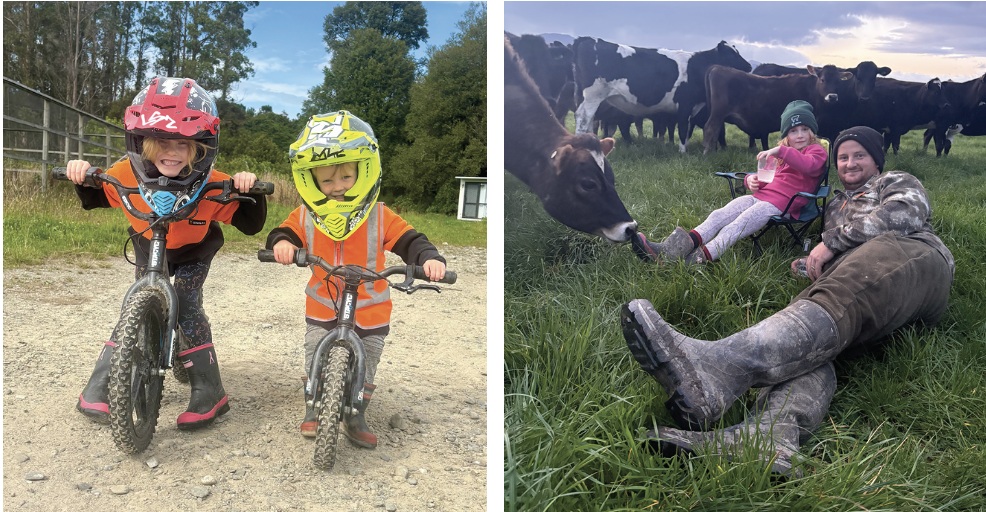
Postpartum psychosis struck Abbi shortly after the birth of each of their two children, Freya, now six years old, and Arlo, now four, with Abbi then suffering a mental health relapse the year after Arlo was born.
“We’d heard about postpartum psychosis at antenatal classes but I’d never in a million years thought it would happen to me,” Abbi says.
“Experience can be the hardest kind of teacher. It gives you the test first and the lesson afterward.” – Oscar Wilde
The country was under Covid level three restrictions at the time of Freya’s birth which was long and difficult. Abbi also suffered from sepsis in the hours after her delivery.
Then, just a week after she was discharged from hospital, things took a sudden and dramatic turn for the worse as the psychosis took hold and she began hallucinating, believing the house was on fire.
“I sent over 150 texts (none of which I really remember doing) to my mid-wife in the space of 1.5 hours,” she wrote on her Instagram account a year after the event.
“I was sectioned under the Mental Health Act for three weeks, separated from Freya for eight days and then we both spent a further 10 days at Mothers and Babies,” she wrote in 2021 in an effort to raise awareness about the condition.
“What I didn’t realise when I wrote that post was the number of people who would private message me and say they’d been through something similar,” she says now.
Once she was through the acute psychosis, it was a slow road to gradual recovery, re-bonding with her infant daughter and finding her feet as a new mum while the daily life of dairying carried on.
Although they were both fearful of a repeat when their next child, Arlo, was born, Abbi says they had thought they’d got lucky when, by two weeks after his birth, she was still well.
But, out of the blue, the psychosis reoccurred and she was again sectioned under the Mental Health Act for her and Arlo’s protection until the disorder was treated. The following year she suffered a relapse.
“We were in the process of moving here, moving house, moving farms, moving cows and I was locked in a psych ward. There’s no nice way to put it. You could call it something different but it was a pretty horrendous experience,” she says.
While the condition is rare, Abbi says more needs to be done to raise awareness and lift the stigma attached to it and other mental health problems.
In the case of postpartum psychosis, there can be a number of contributing factors such as birth trauma, sleep deprivation and family history.
“But I think nowadays too we put women up on this kind of pedestal if they have their baby, put them up on their back and get back out farming, so you’re out there carrying on doing all the things. I thought that’s what my life was going to be like but then it was so far from that.
“If you look back in history, when women had babies, people gathered around them supported them in the community as well as having aunties and grandparents,” she says.
Creating that village in a physical way is the ideal but creating support online can go a long way to helping rural women, in particular, feel less alone.
There’s a need for the Dad’s too. Frikkie says not once did any health professionals offer him support or check in to see how he was coping. It was through Abbi’s willingness to share her experience that other Dads who had been through similar challenges reached out to him.
“They’d found the same thing – that there wasn’t much support for the partners.”
Abbi’s journey to build her own skills and share them with others had started after her experience with burnout in 2013. She sought out information on wellbeing and nutrition and the importance of work-life balance, sharing tips and knowledge through her Instagram social media account, Abbiayre, and through Farmstrong.
After her experiences with postpartum psychosis, she built further on those skills, proactively seeking them out herself and learning about relaxation, meditation, breath work, nutrition and managing sleep.
That knowledge and the actions she takes has proven its worth, giving her resilience.
“It can be hard to step back and make time when you have all these farming goals and you’re excited about what you’re doing. You get caught up, but it’s so important to check in with yourself and just really work on getting more balance,” she says.
“It’s important to understand how closely linked nutrition and gut health are to mental health and also the role of good sleep. Getting that right can go a long way as a proactive measure to good mental health. It’s also important to understand that once you are stressed, digestion can be upset, your body struggles to take in the nutrients it needs, sleep can be affected and so the cycle starts to spiral down,” she says.
Sharing her insights and her story through Farmstrong and her own social media has been part of her healing and an important way to give others not only practical tools, but also hope, as her effervescent energy and contagious smile show it’s possible to come through dark times.
From super yachts and golf to the dairying dream
At the outset of her working life, Abbi had thought the high seas might be where her career was heading. She completed a super yacht course and took part in a yacht delivery from St Martin in the Caribbean to Tonga, but then pivoted to a career on the land, working on dairy farms firstly as a way to carry out practical work requirements for study at Lincoln she had intended to do.
Frikkie, originally from Zimbabwe, moved to New Zealand with his parents in 2002. They were drystock farming in Canterbury, near Windwhistle and Terrace Downs Golf Resort. He’d relief milked growing up but initially wanted to be a professional golfer.
“That didn’t quite work out,” he chuckles. While he’s not making a living out of it, he’s no slug either with a nine handicap under his belt.
Frikkie too saw the more attainable opportunities in dairying and it was while he and Abbi were working on neighbouring farms in Canterbury that they met and became a couple. Over the Fence Ltd became the name of their farming business as a nod to those beginnings.
“We’ve done a lot of development on Larry’s Creek over the past three years, a lot of regrassing, and I think we’re starting to turn the corner there now and see pasture production start to lift.” – Frikkie Terblanche, West Coast
The pair began working on farms together in 2014/15 as Abbi tentatively returned to dairying after burnout. Season by season they took on bigger farms and roles. From 2017 to 2021 they were contract milking larger farms in Canterbury.
Abbi says she’s fuelled by connection and during that time, roles she took on within organisations such as Dairy Women’s Network, Farmstrong and Agri-Women’s Development Trust (AWDT), helped her immensely, providing educational stimulation, an off-farm outlet and a way to share her story to help others.
Going West
In 2021, when Freya was a year old, they made the move to the West Coast to take up an equity partnership, 1200-cow sharemilking job. In 2023, they struck out on their own and now lease two farms near Reefton – Waitahu and Larry’s Creek.
The aim is to build equity quickly to enable farm ownership on the Coast and run a farm system that supports a great work-life balance.
The couple made the conscious decision that while there are a number of factors in farming you can’t control such as weather and payout, there are still plenty of factors you do control.
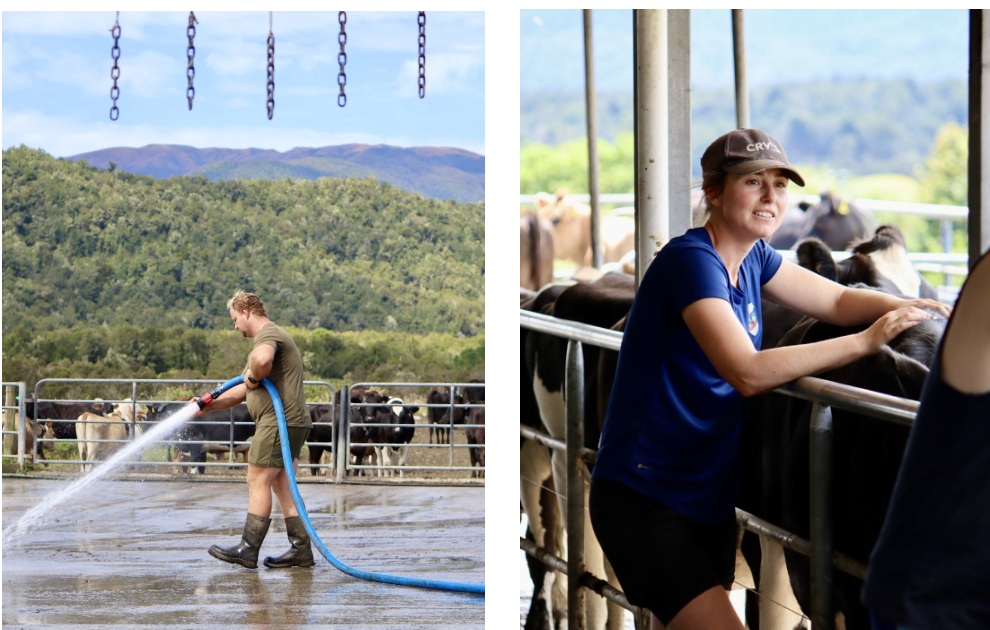
Staffing levels and rosters are two they focus on to ensure they and their staff are able to get critically important time off and achieve work-life balance. In their farming business now, they run a five and two roster along with employing two people on each of the two farms.
“When we analysed the hours from last season for our staff, they worked an average of 35 hours a week.”
Because Abbi and Frikkie are both hands on farming, work can become all-consuming. They’ve also learned that to truly get a break they have to get away from the farm completely on a regular intermittent basis throughout the year, sometimes together and sometimes individually.
Over the years they’ve used livestock as a means to build equity, buying and selling at the right times to maximise gains. They’ve made off-farm investments too that included residential property.
Frikkie says their lease for Waitahu is a hybrid style arrangement where they are leasing to buy, making payments towards the purchase over five years, after which time they need to secure the finance to buy the property. They’ve just completed the second year of that agreement and have their sights laser focused on the target. They want to then get in a position to buy Larry’s Creek farm.
“We’ve done a lot of development on Larrys Creek over the past three years, a lot of regrassing, and I think we’re starting to turn the corner there now and see pasture production start to lift,” Frikkie says.
The couple has dropped cow numbers at Larry’s Creek over the past three seasons while they’ve been developing it, taking their total cow numbers across both farms from 640 to 500. It’s allowed them to protect pasture residuals and reduce the pressure to buy in feed. Palm kernel and summer turnips are used to manage feed deficits through the milking season while supplements made on support land are used for wintering.
A focus on improving per cow performance and pasture management has meant a lift in production and, had the weather through autumn in the last season not been so wet, they may have hit the record production they’d been on target for in March.
Production is only part of the picture, with the couple striving to consistently manage costs – because it’s profit that will build their equity.
A drought in the 2024/25 season added expenses and reduced income, squeezing their profit margin. They monitor their cashflow variance monthly and regularly review their position with their banker and accountant so they know they are on track.
Last season, they invested in Halter technology to more tightly manage grazing and securely contain animals, particularly on the developing land and wintering crops, as well as get insights from cow monitoring for mating and help reduce work load.
“We’ve seen returns already from being able to identify non-cycling cows accurately and early so we can treat them in time to then manage mating to improve our calving spread,” Abbi says.
Even if treated cows didn’t get in-calf to the first insemination, they were at least cycling and able to be mated again within the six-week window. Short gestation semen was used to help condense the calving spread so that last spring they achieved 92% calved in six weeks from the planned start of calving despite a 62% six-week in-calf rate.
They do an early pregnancy scan to check for phantom cows – cows that have not shown a heat after mating but also aren’t pregnant – allowing them to be treated and mated to help reduce overall empty rate. Last spring, the empty rate was 12% and their aim is to get that down to 8%.
Abbi is the artificial insemination (AI) technician for the farm. The couple are aiming for a predominantly Jersey herd. They use CRV genetics and the mating plan for this year is to use sexed semen over the top 100 animals based on herd tests and liveweights, top breeding worth sires over the mid-range cows and beef semen on the bottom group.
The hard working pair have their eyes set on the future – the future of their herd, their business and their family, with a life on the farm that truly allows them to find just the right balance.