Your brain and burnout
Understanding what’s happening in your brain when it’s constantly overloaded can help you recognise early signals all is not well. Listening to those signals and using some practical tools can help you reset and find balance again. Words Lance Burdett.

It may be difficult to create work-life balance in what’s arguably the busiest period in the dairying calendar, but having a break off-farm scheduled in the future, learning how to switch off mentally and understanding the neuroscience of burnout can help get you through.
Clinical burnout comes as a result of overloading the brain and is often associated with jobs that are office based. But in today’s farming businesses, mental load is a real factor. There are budgets to prepare, data and records to manage, technology to navigate, staff to organise and animals in your care. The juggling act is real and consequences of getting things wrong can be serious.
Added to that, there are the physical demands of long days and short nights without enough sleep.
Stress can be high and our brains can perceive all these challenges as a threat. Its response is designed to protect us from danger – flight, fight or freeze mode activated.
But problems develop when the brain’s emergency response remains activated long after the immediate pressure has passed. Stress can become damaging when it accumulates without adequate recovery.
Preventing burnout requires understanding what the brain is trying to do and recognising when a useful short-term response has become a long-term state.
When the brain detects danger or uncertainty, it activates the fight, flight or freeze response. This can happen because of a physical threat, but it can also be triggered by workload, conflict, financial pressure, criticism or uncertainty about the future.
The brain’s primitive survival systems react faster than the prefrontal cortex, the area involved in reasoning, planning, emotional regulation and decision making. Stress hormones, including adrenaline and cortisol, are released. Heart rate increases, breathing becomes faster, muscles tense and attention narrows towards the perceived threat.
This response is valuable when immediate action is required, but modern stressors are rarely resolved by physically fighting or escaping. A farmer could experience many of the same physical reactions when faced with a rapidly mounting list of tasks that ‘must be done’ today, staffing issues or bad weather events.
Under sustained stress, people can become increasingly emotional and reactive. The connection between the emotional brain and the prefrontal cortex becomes disrupted during the fight or flight response.
The amygdala, which helps identify threats and generate emotional reactions, begins to dominate, while access to calm reasoning becomes more difficult.
This helps explain why a stressed person may struggle to concentrate, solve simple problems or respond patiently. They may interpret neutral comments as criticism, become unusually defensive or make decisions they later regret.
Negative thoughts can also become repetitive. Stress can strengthen a cycle where threat focused thinking activates the amygdala, increases cortisol and further reduces access to logic, empathy and creativity.
This is not evidence that the person has suddenly become incompetent. It is evidence that the brain has shifted its priorities from thoughtful decision making to immediate survival.
Burnout develops when pressure continues without enough physical, emotional or mental recovery. It is more than ordinary tiredness. Someone approaching burnout may feel exhausted despite resting. They may feel detached from work, irritable, forgetful or unable to complete tasks that were previously manageable.
One danger is that people often respond to early burnout symptoms by leaning into it and working harder. Falling productivity creates anxiety, so they extend their hours, skip breaks and sacrifice sleep. This removes the recovery their brain needs, creating a downward spiral.
There are some practical ways we can get our prefrontal cortex back in the driving seat.
“Burnout develops when pressure continues without enough physical, emotional or mental recovery.” – Lance Burdett, Warn International
Walking, writing, talking and sighing
Walking or physical activity is one – which may seem a bit nonsensical for a farmer. But if you’re stuck in the tractor, at your desk or on your motorbike – getting out and getting physical will help in moments of high stress.
It gives the body an outlet for the physical stress response. It helps use the adrenaline and cortisol released during stress while increasing oxygenated blood flow and supporting a return to clearer thinking. Exercise may also improve mood through the release of endorphins.
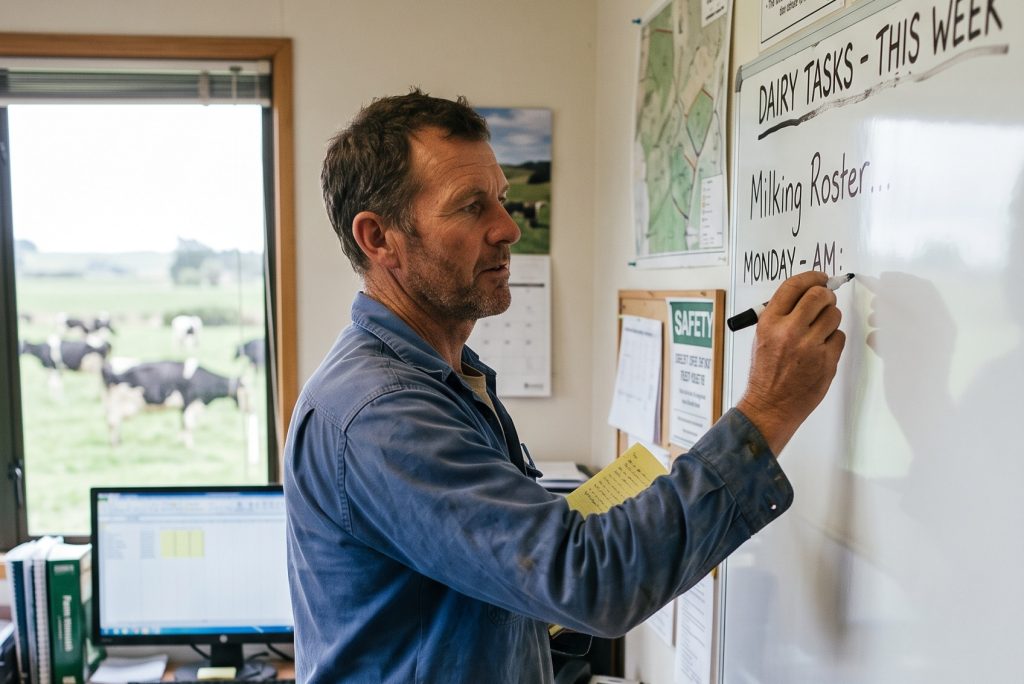
Writing things down – on paper, in the yellow notebook or up on the whiteboard can help too. Writing requires thoughts to be placed into a logical sequence. A vague sense that “everything is going wrong” can become a list with each task or problem put in perspective, given a possible solution or assigned to someone else. Writing also moves the problem out of the mind and onto somewhere physical, reducing the pressure to keep mentally rehearsing it.
Talking performs a similar function. Describing an experience requires the brain to organise it into language. A trusted listener can provide perspective, challenge catastrophic assumptions and reduce isolation. Importantly, talking also allows emotions to be expressed rather than continually suppressed.
Healthy sleep, regular movement, social connection, adequate hydration, nourishing food and mentally engaging activities also support brain health. They need to become habits not optional extras. They provide the conditions in which the brain can recover, adapt and form healthier patterns.
A physiological sigh clears our head of all thoughts so that we can come back to the moment and think properly. When feeling overwhelmed, frozen and unsure of what to do next, take a big deep breath to fill the lungs and sigh out fully to expel as much air as possible. The physiological sigh calms the body’s stress response, which helps the prefrontal cortex regain control, making thinking easier.
Know the signs and act
Preventing burnout also means noticing personal warning signs. These may include continual disturbed sleep, constant irritability, withdrawing from others, relying heavily on alcohol or stimulants, losing enjoyment in ordinary activities or feeling unable to switch off. These aren’t signs of weakness, they are signals from your brain and information for you to act on.
“Falling productivity creates anxiety, so they extend their hours, skip breaks and sacrifice sleep. This removes the recovery their brain needs, creating a downward spiral.” – Lance Burdett, Warn International
The brain is signalling that its current demands exceed its available resources. The aim is not to eliminate stress. That would be unrealistic and some stress is necessary for growth and performance.
The aim is to move regularly between effort and recovery instead of remaining permanently in emergency mode.
By walking, writing, talking and addressing pressure early, you can interrupt the survival response and restore access to the logical brain.
People think burnout comes on suddenly, but your brain will have been sending you signals over a long period. Understand what those signals are and listen to them.
Preventing burnout rather than recovering from it is a much better course of action. It begins by paying attention before exhaustion becomes collapse.
Be kind to yourself. There are few people, even those you might think have it altogether, who have a perfectly balanced life. Too many of us put unfair, self-imposed demands on ourselves and sometimes you may have to step back and ask what is truly sustainable, what help do I need rather than trying to do it all.