Finding Security
Buying their first farm has been a roller coaster ride for a young Canterbury couple, but taking on land ownership has put them in the driver’s seat and more firmly in control of their future. Words Anne Lee.
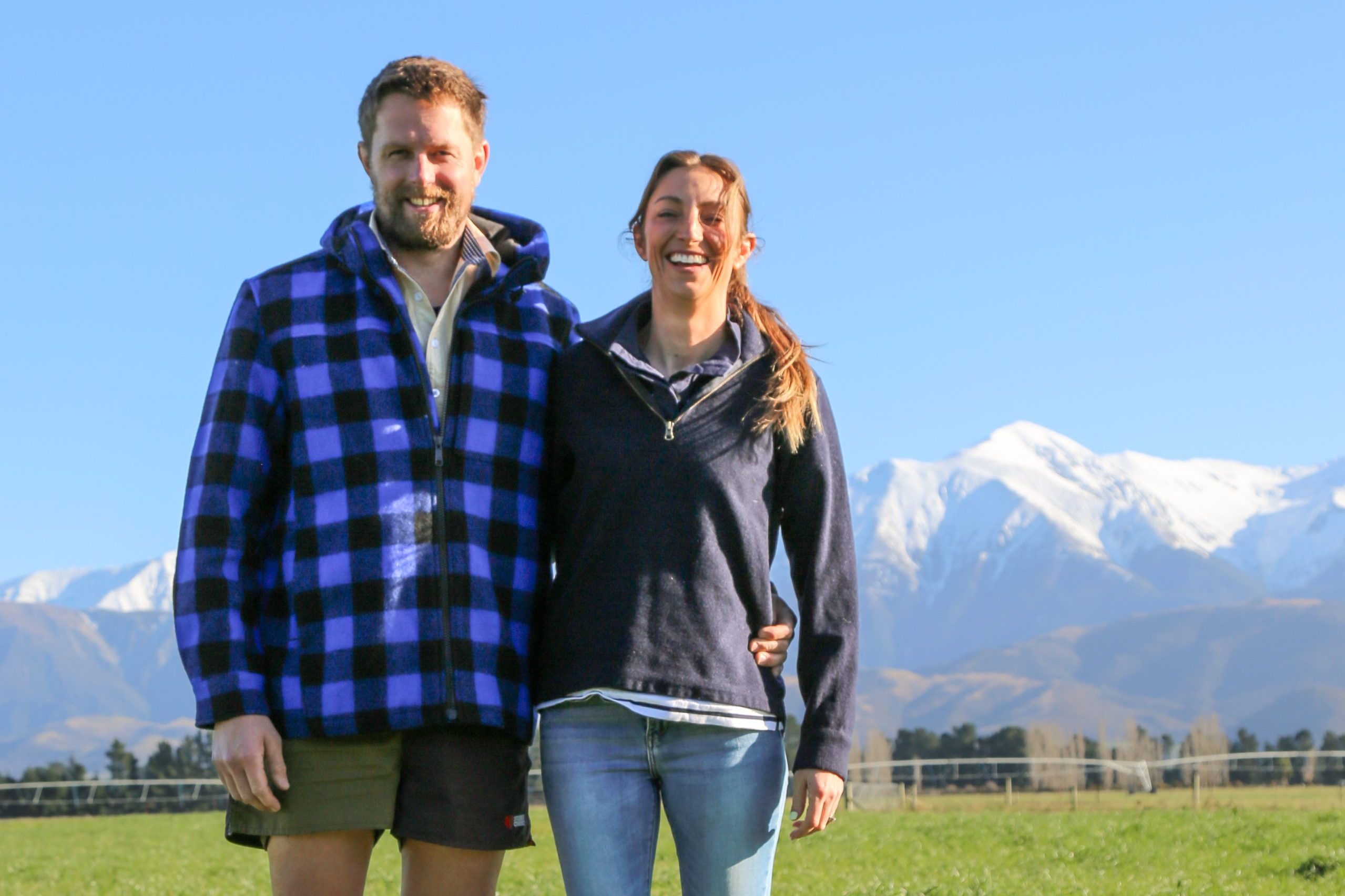
For the first time in 16 years, Braden Barnes didn’t spend the final weeks of July setting up springer paddocks and gearing up for calving. For wife, Biddy, it was the first time in 12 years that she hasn’t had calf pens ready for the onslaught of hundreds of calves.
In April, the couple confirmed their first farm purchase, with the support of the Fonterra and ASB First Farm Loan, in conjunction with the New Zealand Dairy Industry Awards Trust, buying a 200ha dairy support block near Springfield with a view to converting it.
Buying a farm, in what has been a hot dairy market in Canterbury, wasn’t a straightforward process and it meant the pair have ridden a rollercoaster of emotions, getting their hopes up, only to have them dashed when other offers were accepted ahead of theirs.
“It was actually really hard because you try not to get too excited and go there in your mind like you’re living there, but if you don’t get excited you don’t have the drive to get through the process,” Biddy says.
Having a place of their own, a place to call home, brings with it a huge sense of security and control. “It was a good feeling to know this is our place now. We’re here on our terms and it’s up to us where we go from here. When you have kids, that becomes so important,” she says.
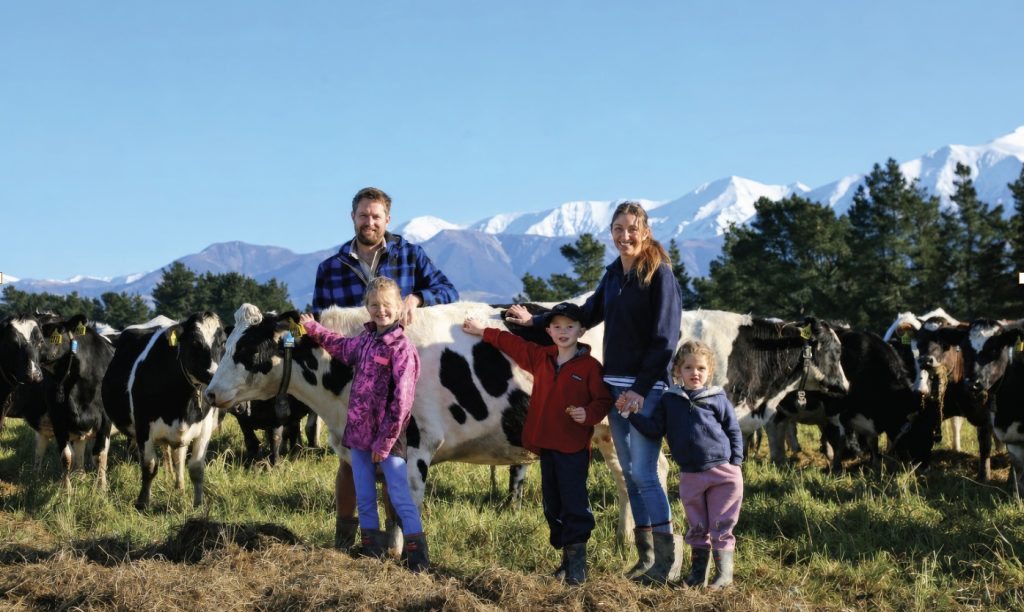
They’ve been large-scale contract milkers and herd owning sharemilkers and while they’ve been high achievers, they’ve also experienced the stress that comes with contracts unexpectedly coming to an end, the upheaval of moving on to take up new opportunities and, at times, that feeling of insecurity when the balance of power is tipped strongly in another’s favour.
Braden grew up in Manawatū on a dairy farm and after spending a few years travelling and a year in Canada on a dairy farm, returned to New Zealand and took up a job in Culverden in 2012.
Biddy, while not from a farm, had always gravitated to farming as a career and qualified as a vet nurse at Massey University before heading overseas to work in Singapore and then the United Kingdom.
“If you don’t get excited you don’t have the drive to get through the process.” – Biddy Barnes, Canterbury
When she returned home, she too decided farming held great opportunities and the outdoors, animal centric life she wanted. As fate would have it, she ended up on the same farm as Braden.
By 2016, they had joined forces as a couple and started their contract milking business, moving south to contract milk 1500 cows on two farms owned by one entity. Three years later, at the end of that contract, an unsuccessful re-negotiation meant they returned north to Culverden to take up a 1000-cow contract milking job on one farm. After two years there, they moved to Oxford to take on a 50/50 herd owning sharemilking job with 1150 cows. They used their savings, borrowed against a rental property they owned and had some assistance through family succession to purchase 960 cows. Over the following years, they purchased rising two-year-olds (R2s) and eventually the remaining 230 cows.
Through their career, they had built equity by saving the profits from their contract milking and sharemilking jobs, rearing extra youngstock, buying cows and buying the rental property.
They completed a three-year contract on the sharemilking job and signed up for another two years, but during that time, they decided to explore the opportunity of putting roots down in the area and realising their goal of farm ownership.
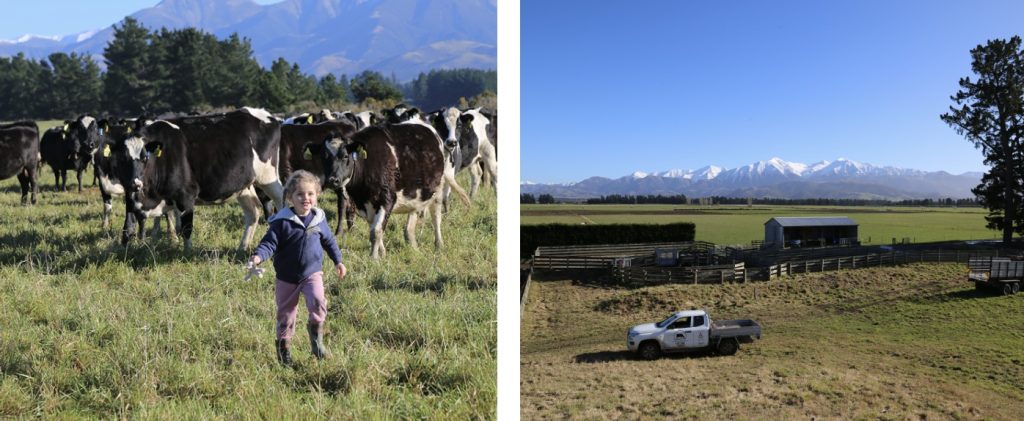
“Our plan was always to use the eventual sale of our herd to help fund a farm purchase. We were never completely confident about the long-term security of our sharemilking position, so we knew we needed to think carefully about our next move. Ideally, that was to buy a place of our own without moving too far from the community we had become part of,” Braden says.
They’d been looking at a run-down property, but their bank, at the time, wasn’t keen on lending on it. “We were actually at Fieldays last year and I was talking to Fonterra about what the process would be of switching to supply them when they told me about the First Farm Loan Award, so I talked to ASB about it then and there and found out we only had until Monday to make an application,” Biddy says.
They were eligible for the award because they’d previously entered the Dairy Industry Awards when contract milking in Culverden. They’d taken out three merit awards in the regional competition and, although they didn’t place, it had been a rewarding exercise for their business growth and had given them confidence they were on the right track.
Putting together their entry for the First Farm Loan award was a big undertaking in a very short space of time but they were one of three winners announced last year in May. The award package includes up to $1 million of ASB Business term lending fixed at 1% per annum for three years. It also includes a Fonterra launch package with $20,000 of Farm Source account credit to help drive productivity and sustainability along with mentoring and additional support to help them make a successful transition to farm ownership.
Braden says having ASB’s Aran Young on their team and Adam Winter from Fonterra helped propel them along in the search for a farm. “We’d been looking, but once we won the award, it was right we’re all going to make this happen and we actually went straight away and put an offer on the farm we’d been looking at, but things were heating up in the market and we got into a multi-offer situation there and missed out,” Braden says.
They went through the process of assessing a farm purchase as an equity partnership too. “That was a good exercise because we got to crunch the numbers with someone who was very experienced. We learned a lot through that process but we didn’t progress further because the offer we put on a property was unsuccessful,” Biddy says.
“There are a lot of people in jobs connected with the industry who were contract milkers or sharemilkers but they’ve been burned and they’ve left.” – Braden Barnes, Canterbury
By last spring, as prices began to take off, they thought they’d missed the boat. “The award raised our profile I guess, and we had people sending us links to farms for sale, and then someone approached us and I went to look at a farm that ended up not really being at the scale we wanted, but I saw that the farm down the road was for sale.
“We literally stumbled over it, but we got together with Aran and came up with a strategy plan and put an offer in and it was accepted,” Braden says.
“We were so used to not quite getting there that we were pretty surprised and it didn’t really sink in for a while,” Biddy says.
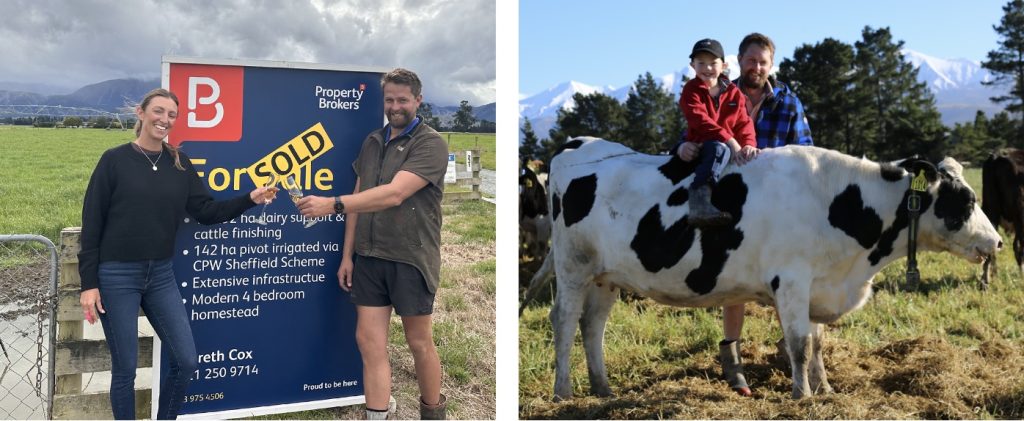
The farm has been run as dairy support for the past five years and has 141ha under irrigation through Central Plains Water (CPW). Its consents enable conversion
with the nutrient load set to drop when it’s run as a milking platform.
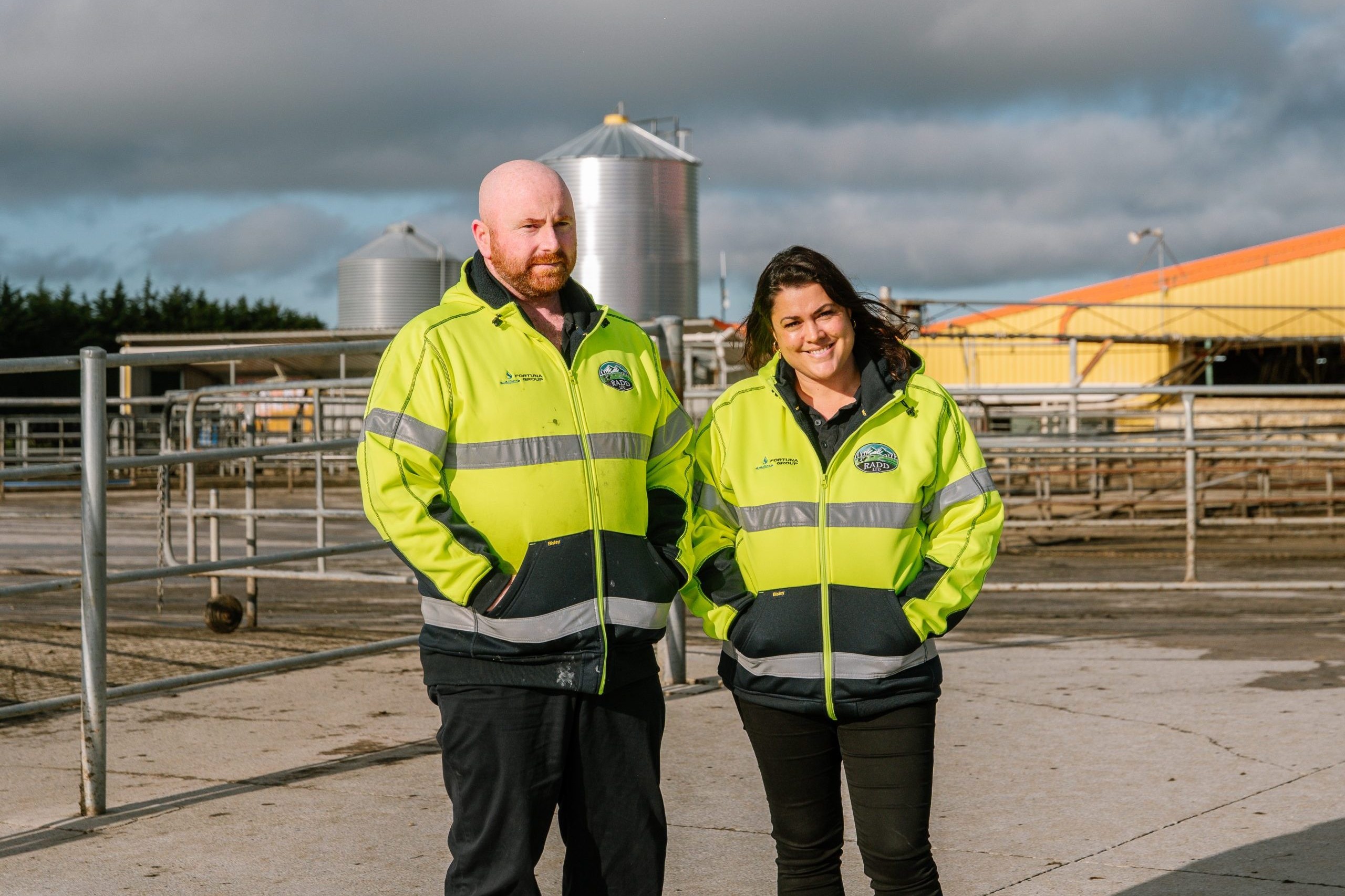
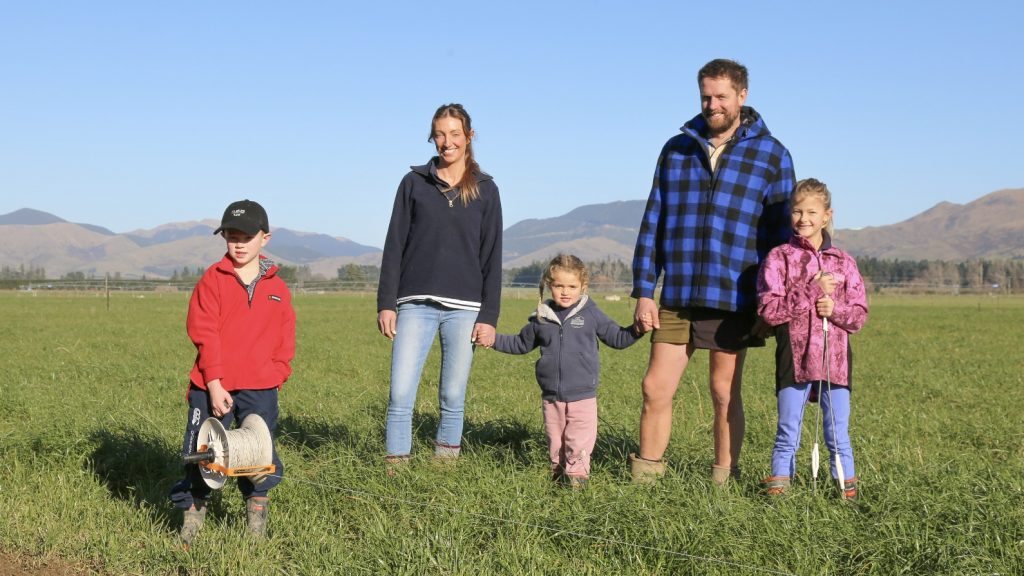
Braden and Biddy are now living on the property, called Tussock Flat, and are in the planning stages of the conversion process for what’s likely to be about a 600-cow operation, deciding where the farm dairy would go, what size platform they’ll install and where the lanes will go as part of the overall farm design.
Carrying on as a dairy support block and wintering cows could be a profitable option, particularly with the growing demand from the number of conversions over the past two seasons. But Braden thinks that with this season on the sidelines, they’re going to be champing at the bit to get back into milking cows and all that entails.
Looking back over their progression journey, they say sharefarming agreements have enabled growth but at times they’ve come at a personal cost. “There is a power imbalance there and when things go wrong, it can be crushing.
“People can go into it naively. We saw that with someone stepping straight into a situation we’d just come out of and they’d seen what had gone on. Then the same thing happened to them. They left the industry,” Biddy says.
“There are a lot of people in jobs connected with the industry who were contract milkers or sharemilkers but they’ve been burned and they’ve left,” Braden says.
“When you’ve got your whole life invested in that contract – it’s your home, your work, your kids are at school in the area, you’re part of the community – and everything can just be ripped away from you.” – Biddy Barnes, Canterbury
“Even when you think you have a great agreement, I think you’re actually more protected as an employee under the Employment (Relations) Act. As an employee, you’re much more secure than you are as a contract worker.
“When you’ve got your whole life invested in that contract – it’s your home, your work, your kids are at school in the area, you’re part of the community – and everything can just be ripped away from you.
“There is a power imbalance and as a contractor you could feel like you just can’t speak up because you have so much at risk,” Biddy says.
If all goes well, contract milking and sharefarming are great ways to make good money but you must have solid advice going in, they say.
“We’ve never had any major problems financially with our contracts but there are people out there who make no money and I just wonder how did they get into that situation – how did they sign up to an agreement where that’s the outcome?” Braden says.
For the couple, buying their farm may have seemed like the end goal but it’s just the beginning of a whole new era – an era where they’re extremely grateful for the journey they’ve had but they’re also excited to truly be in the driving seat now.